Moving Beyond Perimeter-Based Security
Traditional enterprise security models were designed around relatively predictable boundaries. Users worked from corporate locations, applications operated primarily within managed data centers, and network location provided an important signal of trust.
Modern environments are different. Employees work from multiple locations and devices. Applications span data centers, SaaS platforms, public cloud, and distributed architectures. Partners and third parties require controlled access. Privileged identities interact with increasingly complex technology estates. Sensitive data moves across systems that no longer share a single security perimeter.
Zero Trust addresses this change by replacing implicit trust with explicit, continuously evaluated access decisions. The objective is not to deploy one Zero Trust product. It is to progressively build an architecture in which access is granted according to identity, device posture, resource sensitivity, context, risk, and policy.
This playbook provides a practical approach for moving from Zero Trust principles toward an implementable enterprise program.
1. Define the Zero Trust Business Objective
Zero Trust programs should begin with business and security outcomes rather than technology procurement. Organizations need to understand which access problems they are trying to solve and which resources require stronger protection.
Common objectives include:
- Reducing reliance on broad network trust
- Strengthening workforce and privileged access
- Securing remote and hybrid work
- Protecting cloud and SaaS environments
- Reducing lateral movement opportunities
- Improving third-party access control
- Protecting sensitive applications and data
- Applying more consistent access policy across hybrid environments
A clearly defined objective prevents Zero Trust from becoming an open-ended infrastructure modernization program with no measurable security outcome.
2. Establish the Current-State Baseline
Before introducing new controls, organizations should understand how access works today. This includes identities, devices, applications, workloads, networks, data, existing security controls, and the policies connecting them.
Identity
Identify workforce, privileged, service, machine, partner, and third-party identities. Review authentication methods, privilege assignment, account lifecycle, federation, and existing conditional access controls.
Devices
Understand which managed, unmanaged, mobile, contractor, and specialized devices access enterprise resources and what posture information is available when access decisions are made.
Applications and Workloads
Inventory important applications, APIs, cloud workloads, administrative interfaces, legacy systems, and dependencies. Determine which resources still depend heavily on network location for trust.
Networks
Review segmentation, remote access, branch connectivity, internet access, east-west traffic, cloud connectivity, and pathways that could enable unnecessary lateral movement.
Data
Identify sensitive information, where it resides, who can access it, and whether classification and access controls can influence policy decisions.
3. Build Around Core Zero Trust Domains
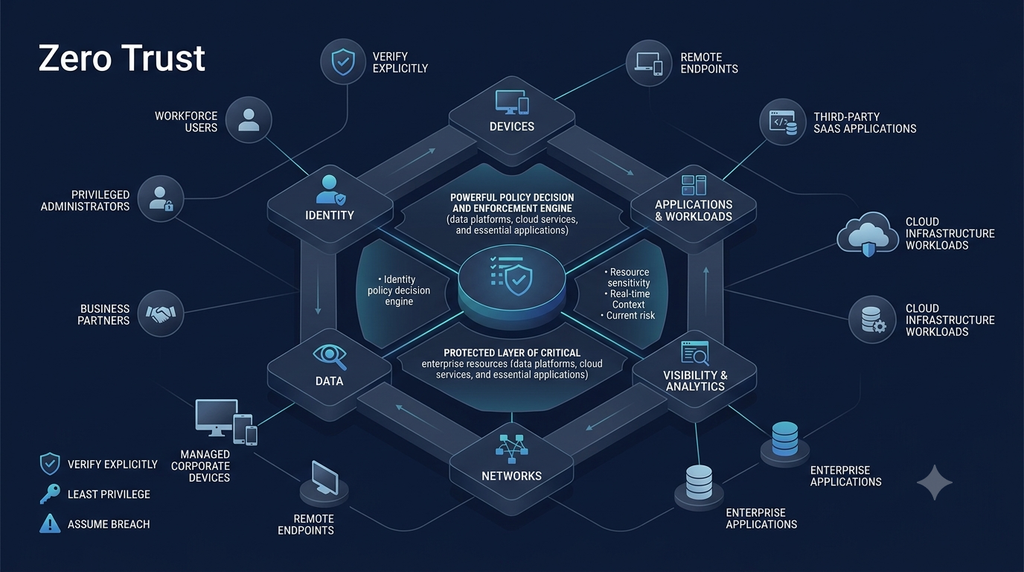
Zero Trust becomes easier to implement when the program is divided into connected security domains rather than treated as a single transformation.
Identity
Establish strong authentication, identity lifecycle governance, least privilege, privileged access controls, contextual access decisions, and appropriate protection for non-human identities.
Devices
Use device identity, management state, security posture, configuration, and risk signals where appropriate to determine whether access should be granted, restricted, or challenged.
Applications and Workloads
Protect access to applications and workloads according to identity and policy rather than assuming that network presence establishes trust.
Networks
Reduce unnecessary connectivity, segment important environments, restrict lateral movement, and move toward application- and identity-aware access where practical.
Data
Connect access decisions with data sensitivity, business requirements, user context, and appropriate protection mechanisms.
Visibility and Analytics
Collect identity, device, network, application, cloud, workload, and security telemetry so access decisions and investigations can incorporate meaningful context.
4. Make Identity the Primary Control Plane
Identity is central to Zero Trust because users, administrators, applications, services, and workloads all require access to enterprise resources.
Organizations should strengthen identity controls through measures such as:
- Strong multi-factor authentication
- Phishing-resistant authentication where risk justifies it
- Conditional and risk-aware access
- Least-privilege access
- Privileged access management
- Joiner, mover, and leaver governance
- Periodic entitlement reviews
- Protection of service and machine identities
Identity modernization should be prioritized where excessive privilege, weak authentication, shared accounts, unmanaged service identities, or inconsistent lifecycle controls create meaningful exposure.
5. Incorporate Device Trust and Security Posture
A valid user identity does not automatically mean the connecting device should receive unrestricted access. Device context provides an additional signal for evaluating access risk.
Relevant signals may include device ownership, management status, operating system health, security configuration, endpoint protection status, certificate identity, and detected risk.
Organizations should define how access changes when a device is unknown, unmanaged, non-compliant, or potentially compromised. The response may range from additional authentication to restricted access or complete denial, depending on resource sensitivity and business requirements.
6. Replace Broad Network Access With Resource-Level Access
Traditional remote access often grants connectivity to a network segment and relies on controls inside that environment to limit what a user can reach. Zero Trust aims to reduce this broad trust by connecting authorized identities more directly to permitted resources.
Organizations should identify where application-level access, Zero Trust Network Access, micro-segmentation, workload segmentation, or other policy enforcement can reduce unnecessary network exposure.
This transition should be risk-based. Legacy applications, specialized protocols, operational technology, and complex dependencies may require staged migration rather than immediate replacement of existing connectivity.
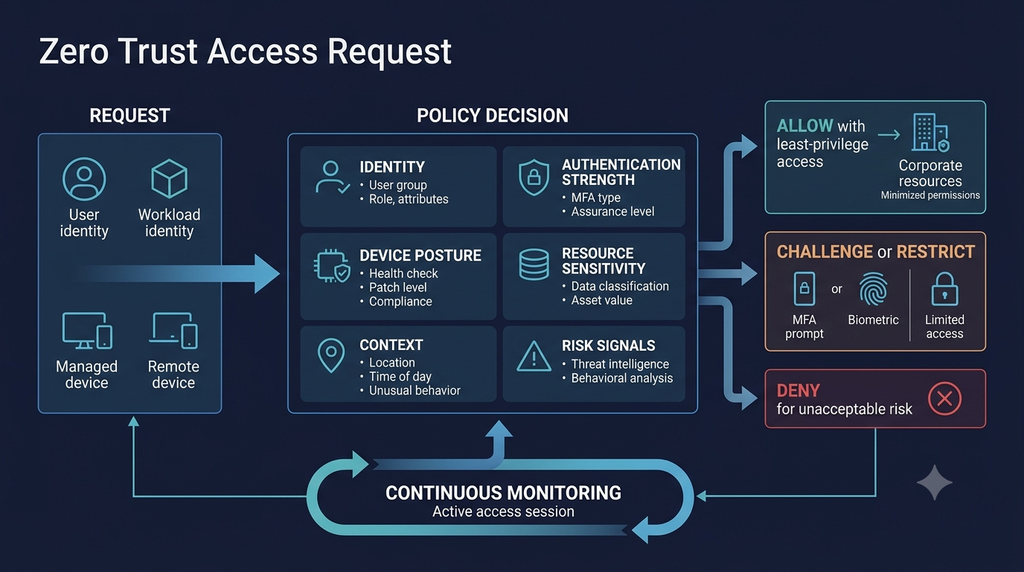
7. Apply Continuous and Context-Aware Access Decisions
Authentication should not be treated as a permanent declaration of trust. Access decisions should incorporate context and, where technically appropriate, be reevaluated when meaningful conditions change.
Useful decision signals may include:
- User and workload identity
- Authentication strength
- Device posture
- Requested application or resource
- Privilege level
- Location and network context
- Behavioral or threat signals
- Data sensitivity
8. Protect Privileged Access First
Privileged identities can create disproportionate impact when compromised. They should therefore receive early attention in a Zero Trust program.
Organizations should consider separating administrative and standard identities, reducing standing privilege, controlling privileged sessions, strengthening authentication, limiting administrative pathways, and monitoring high-risk activity.
Where appropriate, privilege should be granted for the required task and duration rather than remaining permanently available.
9. Extend Zero Trust to Cloud and Workloads
Zero Trust should not stop at workforce access. Cloud services, APIs, applications, containers, automation platforms, and machine identities create their own trust relationships.
Organizations should understand workload identities, service-to-service communication, secrets, API authorization, administrative access, cloud entitlements, and network relationships between workloads.
The objective is consistent: authenticate the requesting identity, authorize only what is required, protect sensitive communication, observe activity, and avoid unnecessary implicit trust.
10. Integrate Visibility, Detection and Response
Zero Trust policy becomes stronger when access systems can consume meaningful security signals and security operations can understand access decisions.
Relevant integration may include identity events, endpoint telemetry, network activity, cloud logs, privileged access events, application activity, threat intelligence, and security analytics.
This creates an important feedback loop: access controls generate security context, security monitoring identifies changes in risk, and those changes can influence subsequent access decisions.
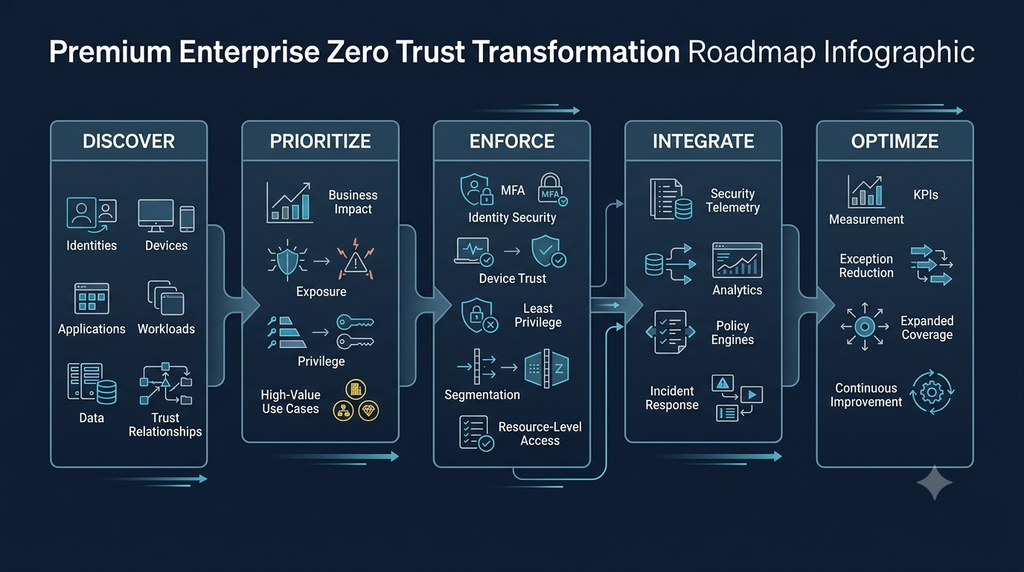
11. Implement Zero Trust in Phases
Attempting to transform every identity, application, network, and security platform simultaneously creates unnecessary complexity. A phased roadmap allows organizations to focus investment where risk reduction and business value are strongest.
Phase 1 — Discover
Identify important identities, applications, devices, workloads, data, network pathways, trust relationships, and existing controls.
Phase 2 — Prioritize
Select high-value use cases according to business impact, exposure, privilege, technical feasibility, and existing security gaps.
Phase 3 — Enforce
Introduce stronger identity, device, application, network, workload, and data access controls for prioritized use cases.
Phase 4 — Integrate
Connect policy enforcement with security telemetry, analytics, response processes, and broader technology operations.
Phase 5 — Optimize
Measure effectiveness, reduce unnecessary friction, address exceptions, extend coverage, and continuously improve policy.
Zero Trust Implementation Checklist
Identity
- Important workforce, privileged, service, and third-party identities are understood.
- Strong authentication is applied according to risk.
- Excessive and standing privileges are being reduced.
- Identity lifecycle processes are defined.
Devices
- Device identity and management status are available for important access decisions.
- Security posture requirements are defined.
- Unmanaged and non-compliant device access is controlled.
Applications & Networks
- Critical applications and access pathways are mapped.
- Broad network access is being reduced where practical.
- Important environments are appropriately segmented.
- Legacy dependencies and migration constraints are documented.
Data & Workloads
- Sensitive data and important workloads are identified.
- Workload and machine identities are appropriately controlled.
- Access policy reflects resource sensitivity where feasible.
Visibility & Operations
- Relevant identity and access events are monitored.
- Security signals can influence high-risk access decisions where appropriate.
- Exceptions are documented and periodically reviewed.
- Zero Trust effectiveness is measured and improved over time.
12. Measure Zero Trust Progress
Zero Trust maturity should be evaluated through measurable improvements rather than the number of technologies purchased.
| Area | Example Indicator |
|---|---|
| Identity | Coverage of strong authentication and risk-based access |
| Privilege | Reduction in unnecessary standing privileged access |
| Devices | Percentage of important access decisions incorporating device posture |
| Applications | Critical applications protected by explicit access policy |
| Networks | Reduction in unnecessary broad connectivity and lateral pathways |
| Workloads | Coverage of controlled workload and machine identities |
| Visibility | Coverage of relevant access and security telemetry |
| Governance | Exceptions reviewed and remediated within defined cycles |
Common Zero Trust Implementation Mistakes
- Treating Zero Trust as a single product purchase.
- Attempting enterprise-wide transformation before defining priority use cases.
- Focusing on network controls while leaving identity and privilege weaknesses unresolved.
- Ignoring legacy applications and operational dependencies during architecture design.
- Creating restrictive policies without considering user experience and business operations.
- Failing to integrate access controls with monitoring and response capabilities.
- Measuring progress by deployed technologies instead of reduced exposure and improved control.
CIAETO Perspective
CIAETO views Zero Trust as an architectural and operating-model evolution rather than a product deployment. Effective programs connect identity, devices, applications, networks, workloads, data, security visibility, and governance around explicit access decisions.
A practical implementation should begin with high-value access scenarios, strengthen the controls that reduce meaningful exposure, integrate security context where it improves decisions, and expand progressively. This approach allows organizations to improve trust decisions without creating unnecessary transformation complexity or business disruption.
Key Takeaways
- Zero Trust replaces implicit trust with explicit, context-aware access decisions.
- Identity should become a primary control plane, but devices, applications, networks, workloads, and data remain essential.
- Privileged access and high-value resources are strong starting points for implementation.
- Broad network connectivity should be reduced progressively where business and technical conditions allow.
- Visibility and security analytics strengthen access decisions and operational response.
- Zero Trust should be implemented through prioritized phases rather than as an enterprise-wide big-bang project.
Related Services
- Zero Trust & SASE
- Identity & Privileged Access
- Network & Secure Access
- Cloud & Infrastructure Security
- Security Architecture & Strategy
Need Expert Guidance?
CIAETO helps organizations assess existing trust models, prioritize Zero Trust use cases, design practical security architectures, and strengthen identity, access, network, cloud, and security controls through a phased transformation approach.