Cloud Adoption Is More Than Workload Migration
Cloud adoption has become an important part of enterprise technology strategy, but successful adoption requires more than moving applications from one hosting environment to another. Organizations must consider architecture, security, governance, operating models, cost, resilience, skills, data, integration, and the long-term management of increasingly distributed technology environments.
A cloud program that focuses only on migration can create new forms of complexity. Workloads may move successfully while governance remains fragmented, security controls become inconsistent, costs become difficult to understand, and operational teams struggle to manage hybrid environments effectively.
Enterprise cloud adoption should therefore be treated as a transformation of technology architecture and operating practices rather than as a hosting decision alone.
This guide provides a practical framework for evaluating cloud readiness, defining the right cloud strategy, establishing secure foundations, planning migrations, operating hybrid environments, managing cost, and continuously improving cloud capabilities.
1. Define the Business Case for Cloud Adoption
Cloud adoption should begin with clear business and technology objectives. Organizations should understand what problems cloud is expected to solve and what outcomes justify the investment required to transform the environment.
Common objectives may include:
- Improving infrastructure scalability and agility
- Accelerating application delivery
- Modernizing legacy technology platforms
- Improving resilience and availability
- Supporting geographic expansion
- Enabling data, AI, and automation initiatives
- Reducing infrastructure provisioning constraints
- Standardizing technology platforms and operational practices
Cost reduction may be an objective, but it should not be assumed automatically. Cloud economics depend heavily on architecture, consumption patterns, operating discipline, commitments, licensing, data movement, and the ability to continuously optimize resources.
Key Questions
- What business outcomes should cloud adoption support?
- Which technology constraints are limiting current objectives?
- Which workloads are genuine candidates for cloud?
- What capabilities need to improve before migration begins?
- How will cloud adoption change the operating model?
- How will success be measured beyond the number of workloads migrated?
2. Assess Enterprise Cloud Readiness
Organizations should establish a realistic current-state baseline before defining the target cloud environment. Readiness should be assessed across technology, applications, security, governance, people, processes, and financial management.
Application Portfolio
Understand application criticality, architecture, dependencies, lifecycle status, performance requirements, licensing constraints, data relationships, and modernization opportunities.
Infrastructure
Assess data center infrastructure, virtualization, compute, storage, network connectivity, disaster recovery, capacity constraints, and existing automation capabilities.
Security and Identity
Review identity architecture, privileged access, security monitoring, data protection, network controls, vulnerability management, compliance requirements, and the organization’s ability to secure distributed cloud environments.
Operating Model
Determine how infrastructure, cloud engineering, security, networking, application teams, finance, procurement, architecture, and governance functions currently work together.
Skills and Automation
Evaluate cloud architecture skills, infrastructure-as-code maturity, automation, DevOps practices, platform engineering capabilities, operational monitoring, and governance expertise.
Financial Management
Assess whether technology teams can allocate cloud spending, understand workload economics, manage commitments, monitor consumption, and connect cost with business services.
3. Choose the Right Cloud Operating Model
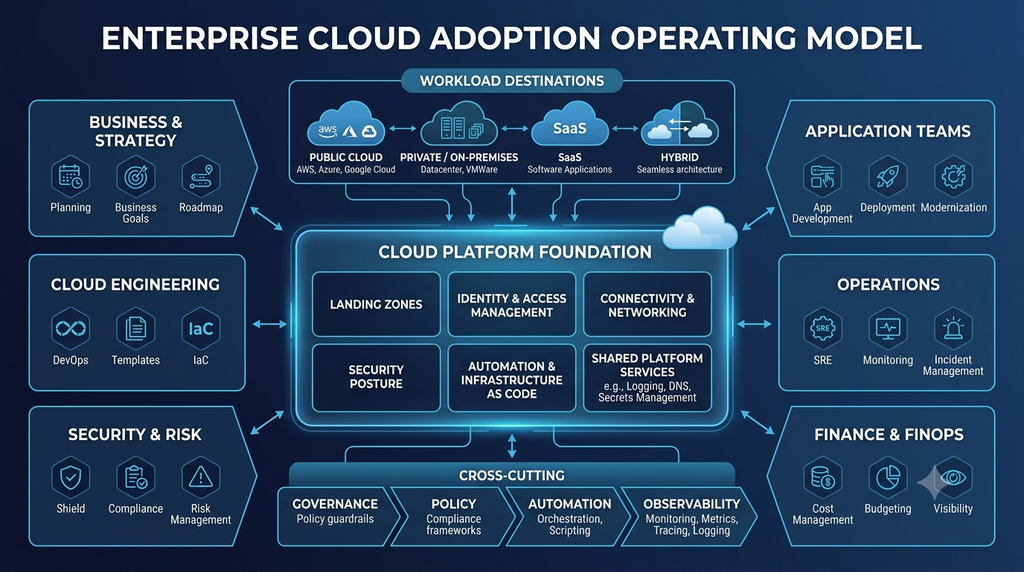
Cloud strategy should reflect the requirements of the enterprise rather than assuming that every workload belongs in one environment. Many organizations will operate across public cloud, private infrastructure, SaaS platforms, edge environments, and existing data centers for an extended period.
The objective should be to establish a coherent operating model across these environments.
Public Cloud
Appropriate where elasticity, managed services, global reach, rapid provisioning, or cloud-native capabilities support application and business requirements.
Private and On-Premises Infrastructure
May remain appropriate for specialized workloads, latency-sensitive systems, legacy dependencies, regulatory requirements, data sovereignty, or economic considerations.
Hybrid Cloud
Combines cloud and existing infrastructure, requiring consistent identity, connectivity, security, observability, automation, governance, and operational processes across environments.
Multi-Cloud
Can provide flexibility and access to differentiated services, but it also increases complexity. Multi-cloud should be driven by genuine requirements rather than adopted simply to avoid dependency on a single platform.
4. Establish a Secure Cloud Foundation
Cloud security should be designed into the foundation before large-scale workload migration begins. Retrofitting controls after multiple teams have created independent environments is significantly more difficult.
A secure cloud foundation should address:
- Account, subscription, or project organization
- Identity federation and access governance
- Privileged administrative access
- Network architecture and connectivity
- Security logging and monitoring
- Configuration standards and guardrails
- Data protection and key management
- Workload security
- Backup and recovery
- Compliance and policy requirements
- Tagging and resource ownership
These controls are often implemented through a standardized landing-zone architecture that provides approved foundations for application and platform teams.
5. Build Governance Into the Platform
Cloud environments can expand quickly. Governance therefore needs to operate through technology and automation rather than relying exclusively on manual approvals.
Important governance areas include:
- Resource ownership
- Approved regions and services
- Identity and privilege standards
- Network and connectivity requirements
- Logging and security monitoring
- Encryption and data handling
- Backup and resilience requirements
- Tagging and cost allocation
- Architecture and deployment standards
- Exception management
Where practical, policy should be embedded into templates, infrastructure-as-code, platform services, and automated controls so compliant environments become easier to create than non-compliant ones.
6. Classify Workloads Before Choosing a Migration Path
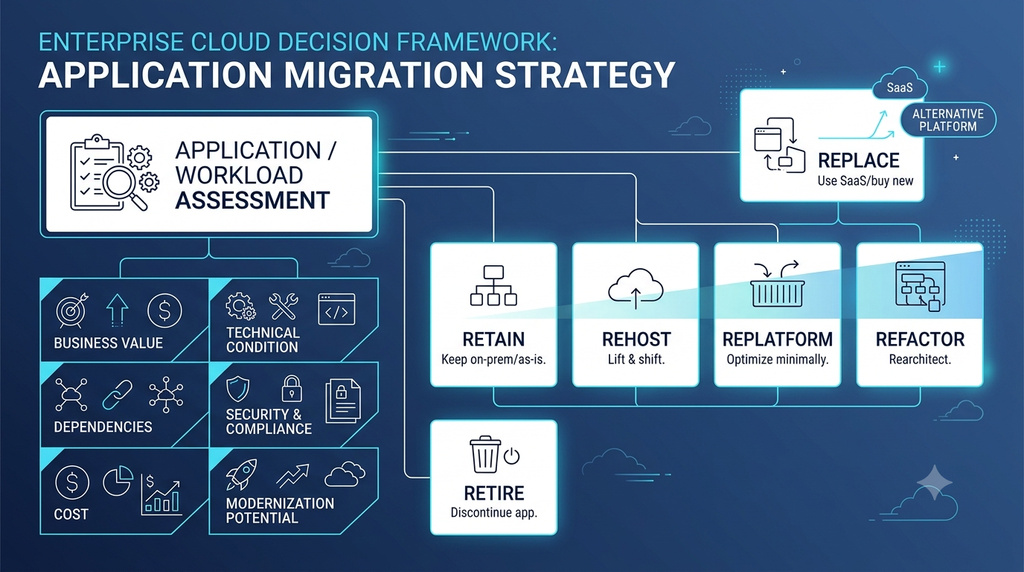
Not every application should follow the same migration strategy. Organizations should evaluate business value, architecture, technical debt, dependencies, lifecycle, security, cost, and operational requirements before selecting a path.
Retain
Keep the workload in its current environment when migration provides insufficient business or technical benefit.
Retire
Remove applications or infrastructure that no longer provides sufficient value or has been replaced by other capabilities.
Rehost
Move the workload with minimal architectural change where speed or infrastructure exit is the primary objective.
Replatform
Introduce targeted platform improvements while avoiding a complete application redesign.
Refactor
Redesign the application to use cloud-native architectures or managed services where the business value justifies the additional effort.
Replace
Replace an existing application with SaaS or another platform when modernization of the current system provides limited long-term value.
7. Understand Application Dependencies Before Migration
Application migration frequently fails because dependencies are underestimated. Applications may rely on shared databases, identity services, file systems, network pathways, integration middleware, batch processes, APIs, monitoring tools, external partners, or undocumented operational procedures.
Organizations should map dependencies before establishing migration waves. Closely connected systems may need to move together or require temporary connectivity between cloud and existing environments.
Dependency analysis also helps identify applications that should be modernized, consolidated, or retired rather than migrated unchanged.
8. Plan Migration in Controlled Waves
Large migrations should normally be divided into manageable waves. Early waves can validate architecture, security, connectivity, operational processes, automation, and support models before critical workloads are moved.
A migration wave should define:
- Workloads included
- Dependencies
- Migration approach
- Security requirements
- Testing criteria
- Rollback or recovery approach
- Operational ownership
- Business communication
- Post-migration validation
Organizations should avoid measuring migration success purely by workload count. The more meaningful question is whether migrated workloads operate securely, reliably, economically, and with clear ownership.
9. Design Cloud Operations Before Scale
Cloud environments require a different operating model from traditional infrastructure. Teams need clear responsibilities for platform engineering, application operations, security, networking, monitoring, cost management, architecture, governance, and incident response.
Operational capabilities should include:
- Monitoring and observability
- Security monitoring and response
- Patch and vulnerability management
- Configuration management
- Backup and recovery
- Capacity and performance management
- Incident and problem management
- Change management
- Service ownership
- Cost optimization
10. Treat Cloud Cost as an Engineering Discipline
Cloud financial management should begin when architectures are designed, not after unexpected spending appears. Cost is influenced by compute architecture, storage tiers, network traffic, managed services, resiliency patterns, licensing, reservations, commitments, and operational behavior.
Organizations should establish FinOps practices that connect engineering, finance, technology leadership, procurement, and business ownership.
Important practices include:
- Consistent tagging and ownership
- Budgets and anomaly detection
- Workload rightsizing
- Removal of unused resources
- Appropriate commitment management
- Storage and data-transfer optimization
- Unit-cost and business-service visibility where practical
- Regular architecture-cost reviews
11. Design for Resilience and Recovery
Cloud platforms provide powerful resilience capabilities, but availability is not automatic. Architecture still needs to account for component failures, regional dependencies, application architecture, data protection, operational errors, identity compromise, and provider service disruption.
Organizations should define resilience requirements according to workload criticality and consider:
- Availability architecture
- Recovery Time Objectives
- Recovery Point Objectives
- Backup isolation
- Data replication
- Identity and access recovery
- Infrastructure recreation
- Application dependency recovery
- Testing and validation
12. Build Cloud Adoption in Phases
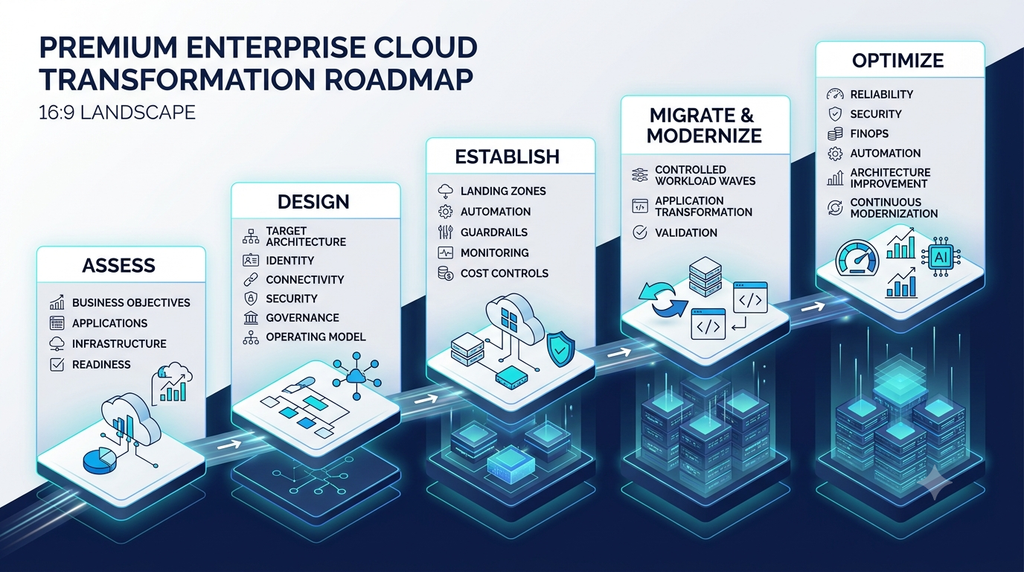
Enterprise cloud adoption is easier to govern when delivered through a structured sequence rather than simultaneous migration and modernization across the entire estate.
Phase 1 — Assess
Understand business objectives, applications, infrastructure, security, dependencies, operating capabilities, skills, governance, and financial readiness.
Phase 2 — Design
Define target architecture, landing zones, identity, connectivity, security, governance, automation, operating model, and migration strategy.
Phase 3 — Establish
Implement secure cloud foundations, policy guardrails, connectivity, logging, automation, cost controls, and operational processes.
Phase 4 — Migrate & Modernize
Move workloads in controlled waves while applying the appropriate retain, retire, rehost, replatform, refactor, or replace strategy.
Phase 5 — Optimize
Improve security, reliability, performance, architecture, automation, developer experience, operational efficiency, and cloud economics continuously.
Enterprise Cloud Adoption Checklist
Strategy & Governance
- Cloud adoption objectives are linked to business and technology priorities.
- Decision rights and governance responsibilities are defined.
- Approved architectures, services, and policy standards are documented.
- Exceptions have clear ownership and review processes.
Security
- Identity federation and privileged access are defined.
- Logging and security monitoring are established.
- Configuration and workload-security standards exist.
- Data protection and key-management requirements are understood.
Architecture & Migration
- Application dependencies are understood.
- Workloads have an appropriate migration disposition.
- Landing zones and connectivity are established before scale.
- Migration waves include validation and recovery plans.
Operations
- Operational ownership is defined for cloud services and workloads.
- Monitoring and observability are implemented.
- Incident, vulnerability, backup, and recovery processes are established.
- Automation is used where it improves consistency and control.
Cost & Optimization
- Resource ownership and cost allocation are visible.
- Budgets and anomaly monitoring are established.
- Rightsizing and waste reduction are continuous practices.
- Architecture decisions consider both technical and economic outcomes.
13. Measure Cloud Adoption Progress
Cloud adoption should be measured through business, operational, security, engineering, and financial outcomes rather than migration volume alone.
| Area | Example Indicator |
|---|---|
| Migration | Workloads moved or modernized according to approved strategy |
| Security | Cloud environments meeting defined security baseline |
| Governance | Resources deployed through approved platform patterns |
| Automation | Infrastructure provisioned through repeatable automation |
| Reliability | Critical cloud workloads meeting availability and recovery objectives |
| Operations | Cloud services with clear operational ownership and monitoring |
| Cost | Cloud spend allocated to accountable owners and services |
| Optimization | Identified cost, security, and architecture improvements completed |
Common Cloud Adoption Mistakes
- Treating cloud adoption primarily as a data-center exit project.
- Migrating workloads before establishing secure landing zones and governance.
- Assuming every workload should move to public cloud.
- Underestimating application dependencies and operational complexity.
- Leaving security and cost management until after migration.
- Creating multiple cloud environments without common identity, policy, logging, and ownership.
- Measuring success by workload migration count rather than business and operational outcomes.
CIAETO Perspective
CIAETO views enterprise cloud adoption as an architecture, security, governance, and operating-model transformation rather than a simple infrastructure migration. The strongest programs establish secure foundations, define clear ownership, classify workloads intelligently, automate repeatable controls, and connect cloud engineering with security, operations, finance, and business priorities.
Organizations do not need to migrate every workload or adopt every cloud-native service to demonstrate progress. A more sustainable approach is to identify where cloud creates meaningful value, establish the platform capabilities required to operate it responsibly, migrate in controlled waves, and continuously optimize architecture, security, reliability, and economics.
Key Takeaways
- Cloud adoption should begin with business and technology objectives rather than workload migration targets.
- Readiness must be assessed across applications, infrastructure, security, governance, skills, operations, and finance.
- Secure landing zones and automated guardrails should be established before large-scale migration.
- Workloads should be classified according to the migration or modernization approach that creates the most value.
- Cloud operations and FinOps should be designed before consumption scales significantly.
- Hybrid environments require consistent identity, connectivity, visibility, security, and governance.
- Cloud adoption is a continuous operating model rather than a project that ends after migration.
Related Services
- Cloud & Infrastructure Security
- Security Architecture & Strategy
- Network & Secure Access
- Managed IT Operations
- Digital & Technology Advisory
Need Expert Guidance?
CIAETO helps organizations assess cloud readiness, design secure cloud foundations, evaluate workload strategies, plan migration and modernization, strengthen cloud governance, and establish practical operating models for secure and sustainable enterprise cloud adoption.