Cloud Security Must Be Designed Before Scale
Cloud platforms can improve agility, scalability, and access to modern technology services, but they also introduce new responsibilities. Security controls that worked effectively in traditional infrastructure may not automatically translate to cloud environments, and the speed of cloud provisioning can amplify weaknesses when governance and architecture are not established early.
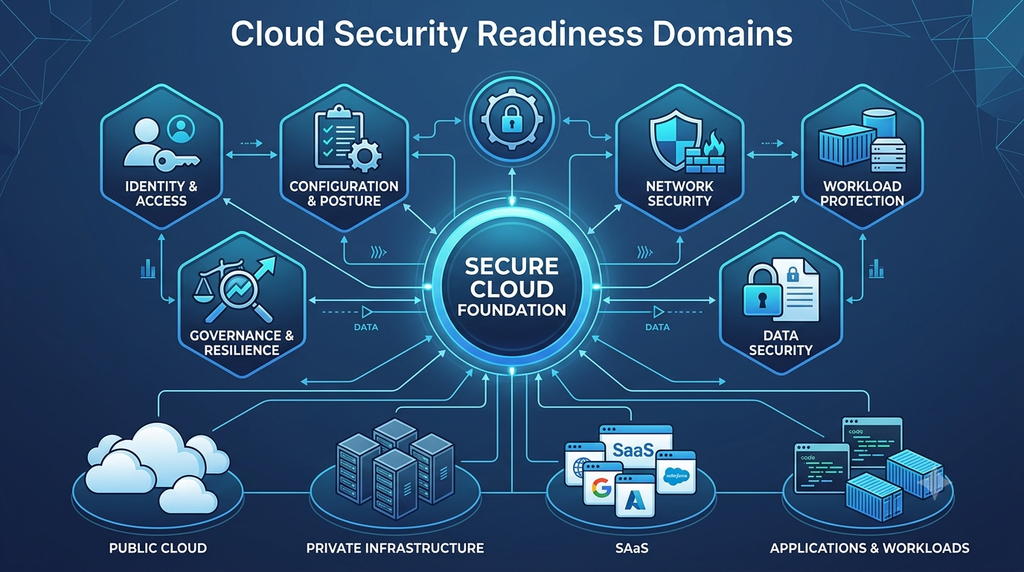
Cloud security readiness therefore means more than deploying individual security products. It requires organizations to understand how identity, configuration, network architecture, workloads, data, monitoring, governance, resilience, and operational responsibilities fit together across cloud and hybrid environments.
This playbook provides a practical framework for assessing those capabilities, identifying readiness gaps, and strengthening cloud security before cloud adoption and workload growth increase complexity.
1. Understand the Shared Responsibility Model
Cloud security responsibilities vary according to the services being consumed. Infrastructure, platform, SaaS, and managed services place different responsibilities on the cloud provider and the customer.
Organizations should clearly understand who is responsible for areas such as:
- Identity and access management
- Operating system and workload security
- Network configuration
- Application security
- Data protection
- Encryption and key management
- Logging and monitoring
- Backup and recovery
- Configuration and compliance
- Incident response
Unclear responsibility creates security gaps because each party may assume the other is providing a control that has not actually been implemented.
2. Establish a Cloud Security Readiness Baseline
Before expanding cloud usage, organizations should assess their existing controls and operating practices across the major security domains that support cloud environments.
Identity & Access
Review federation, privileged access, multi-factor authentication, service identities, machine identities, access lifecycle, and the use of standing privileges across cloud platforms.
Configuration & Posture
Determine whether secure configuration standards exist for accounts, subscriptions, projects, workloads, storage, network services, and other cloud resources.
Network Security
Assess segmentation, connectivity, internet exposure, remote administration, east-west communication, inspection points, and hybrid-cloud connectivity.
Workload Protection
Evaluate vulnerability management, endpoint or workload protection, hardening, runtime visibility, secrets, containers, and serverless security where relevant.
Data Security
Review data classification, encryption, key management, access controls, data movement, storage exposure, backup, and retention requirements.
Monitoring & Response
Determine whether cloud logs, identity events, configuration changes, workload signals, and security alerts are collected, retained, monitored, and integrated with incident response processes.
3. Make Identity the Foundation of Cloud Security
Cloud environments are highly identity-driven. Administrative actions, service access, application communication, automation, and deployment processes frequently depend on identities rather than traditional network location.
Organizations should strengthen identity security through:
- Federated enterprise identity
- Strong multi-factor authentication
- Privileged access controls
- Least privilege
- Role-based access
- Periodic entitlement reviews
- Short-lived credentials where practical
- Controlled service and machine identities
- Secrets management
Privileged cloud access should receive particular attention because a compromised administrative identity can affect large portions of the environment quickly.
4. Establish Secure Landing Zones and Guardrails
Cloud environments should be built from standardized foundations rather than allowing every team to create its own security architecture independently.
Landing zones can provide repeatable controls for:
- Account and subscription structure
- Identity federation
- Network connectivity
- Logging and monitoring
- Security policy
- Encryption requirements
- Resource ownership and tagging
- Backup and resilience controls
- Approved regions and services
Guardrails should help teams deploy securely by default. Where possible, unsafe configurations should be prevented or detected automatically rather than depending entirely on manual review.
5. Reduce Cloud Misconfiguration Risk
Cloud misconfiguration can expose services, identities, storage, management interfaces, and data. Because infrastructure is often created through automation and APIs, configuration errors can also propagate quickly across multiple environments.
Organizations should implement secure configuration baselines and continuously evaluate cloud posture.
- Identify publicly exposed resources
- Detect overly permissive identity policies
- Review insecure storage configurations
- Identify unnecessary network exposure
- Monitor configuration drift
- Validate encryption requirements
- Review logging coverage
- Track exceptions and remediation
6. Design Cloud Network Security Around Workload Needs
Cloud networks should not simply recreate traditional data-center architectures. Connectivity should be designed according to workload communication requirements, trust boundaries, exposure, and operational needs.
Important considerations include:
- Internet-facing workloads
- Private application services
- Hybrid connectivity
- Segmentation between environments
- Administrative access pathways
- Cloud-to-cloud connectivity
- East-west traffic
- DNS and name resolution
- Network monitoring and inspection
The objective is to provide only the connectivity required for workloads and business operations while reducing unnecessary access paths.
7. Protect Cloud Workloads Across the Lifecycle
Cloud workload security should begin before deployment and continue through runtime operations.
Before Deployment
- Use approved templates and images.
- Scan code, packages, containers, and infrastructure definitions where appropriate.
- Control secrets and credentials.
- Apply secure configuration standards.
During Runtime
- Monitor workload activity.
- Detect unexpected behavior.
- Manage vulnerabilities.
- Protect endpoints, containers, and workloads according to architecture.
- Maintain logging and operational visibility.
Workload protection should be integrated with cloud-native services, security operations, vulnerability management, and application security rather than managed as an isolated control.
8. Protect Data Throughout the Cloud Lifecycle
Data security requirements should follow information as it moves through storage, processing, backup, analytics, applications, and integration services.
Organizations should consider:
- Data classification
- Access control
- Encryption in transit and at rest where appropriate
- Key management
- Secrets management
- Data-loss controls
- Retention and deletion
- Backup protection
- Data residency and regulatory requirements
Cloud adoption should not weaken information-governance requirements simply because technology is hosted differently.
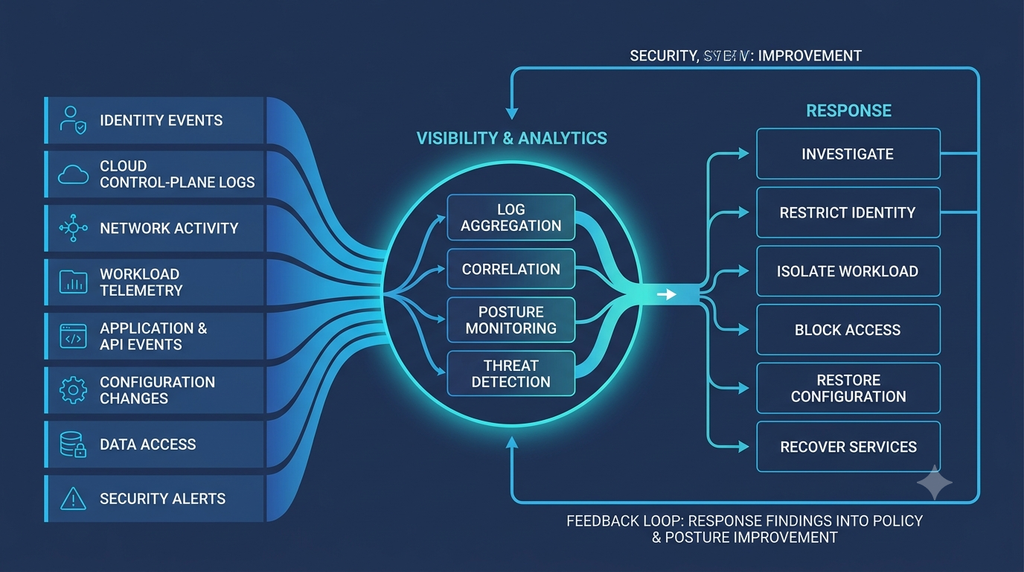
9. Build Security Monitoring Into Cloud Architecture
Security teams need visibility into cloud control planes, identities, workloads, networks, applications, configuration changes, and security services.
Relevant telemetry may include:
- Administrative activity
- Authentication and identity events
- Privilege changes
- Network activity
- Configuration changes
- Storage access
- Workload telemetry
- Security alerts
- Application and API events
10. Prepare Cloud-Specific Incident Response
Cloud incidents can involve compromised identities, malicious API activity, exposed storage, misconfiguration, workload compromise, stolen secrets, or destructive administrative actions.
Response procedures should account for cloud-specific actions such as:
- Restricting compromised identities
- Revoking sessions or credentials
- Preserving cloud logs and evidence
- Reviewing API and configuration changes
- Isolating workloads
- Restricting network access
- Restoring secure configurations
- Coordinating with cloud providers where necessary
Cloud response procedures should be exercised before a significant incident occurs.
11. Design Resilience Into Cloud Security
Security incidents can affect availability as well as confidentiality and integrity. Cloud security planning should therefore include resilience and recovery considerations.
- Protected backups
- Identity recovery
- Infrastructure recreation
- Secure configuration recovery
- Application and data recovery
- Region or service dependencies
- Emergency administrative access
- Recovery testing
A cloud environment should be designed not only to resist compromise but also to recover securely when disruption occurs.
12. Govern Cloud Security Continuously
Cloud environments change continuously as teams deploy resources, adopt new services, create automation, and modify architectures. Security governance must therefore operate as an ongoing process.
Organizations should periodically review:
- Identity and privilege
- Public exposure
- Configuration posture
- Logging coverage
- Workload vulnerabilities
- Data security
- Policy exceptions
- Backup and recovery
- Security architecture changes
Cloud Security Readiness Checklist
Identity & Access
- Enterprise identity federation is established where appropriate.
- Strong authentication protects privileged and important access.
- Standing privilege is minimized.
- Service and machine identities are governed.
Configuration & Governance
- Secure configuration standards exist.
- Landing zones or equivalent foundations are standardized.
- Cloud posture is monitored continuously.
- Exceptions have owners and review dates.
Network & Workload Security
- Internet-facing resources are known and reviewed.
- Critical environments are appropriately segmented.
- Workload vulnerabilities and runtime risks are monitored.
- Administrative access paths are controlled.
Data Security
- Sensitive cloud data is identified.
- Access controls reflect data sensitivity.
- Encryption and key-management requirements are defined.
- Backup and retention controls are established.
Monitoring & Response
- Relevant control-plane and security logs are collected.
- Cloud alerts are integrated with security operations.
- Cloud-specific response procedures exist.
- Response and recovery procedures are tested.
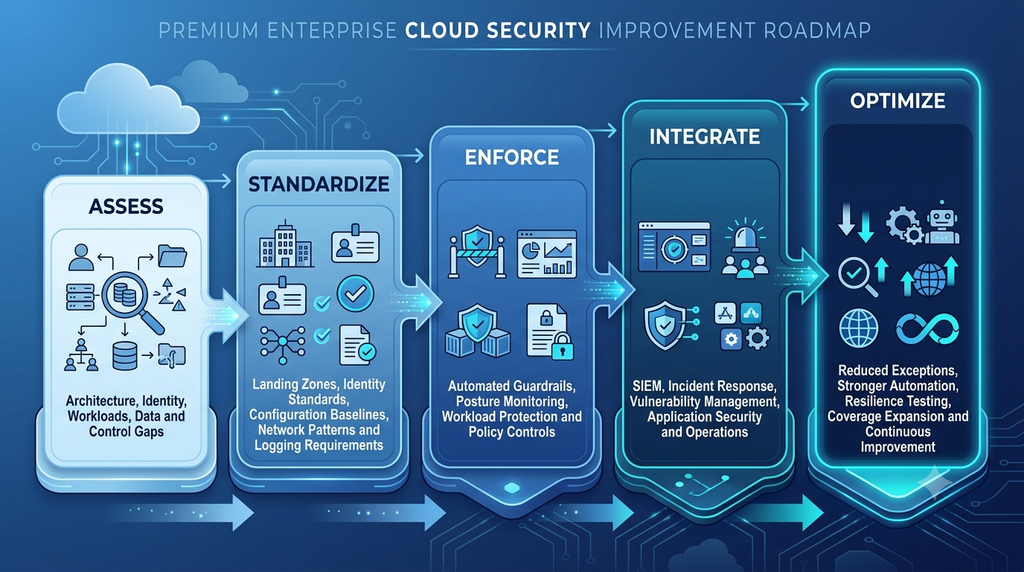
13. Improve Cloud Security in Phases
Phase 1 — Assess
Understand cloud architecture, identity, workloads, data, configuration, monitoring, governance, and existing control gaps.
Phase 2 — Standardize
Define secure landing zones, identity standards, network patterns, configuration baselines, logging requirements, and governance controls.
Phase 3 — Enforce
Implement automated guardrails, posture monitoring, workload protection, identity controls, and security policy enforcement.
Phase 4 — Integrate
Connect cloud security with SIEM, incident response, vulnerability management, application security, operations, and enterprise governance.
Phase 5 — Optimize
Reduce exceptions, improve visibility, strengthen automation, validate resilience, and continuously refine security as cloud environments evolve.
14. Measure Cloud Security Readiness
| Area | Example Indicator |
|---|---|
| Identity | Coverage of strong authentication and least-privilege controls |
| Configuration | Cloud resources meeting defined security baselines |
| Exposure | Known and reviewed internet-facing cloud resources |
| Workloads | Critical workloads covered by vulnerability and runtime-security processes |
| Data | Sensitive cloud data covered by defined access and protection controls |
| Monitoring | Critical cloud services sending required security telemetry |
| Response | Cloud-specific incident-response procedures tested |
| Governance | Security exceptions reviewed within defined timelines |
Common Cloud Security Readiness Gaps
- Using cloud before establishing enterprise identity and privilege standards.
- Allowing teams to create independent environments without common security foundations.
- Relying on manual configuration review rather than automated guardrails and posture monitoring.
- Collecting cloud logs without integrating them into operational security monitoring.
- Protecting infrastructure while overlooking workload and machine identities.
- Assuming cloud-provider resilience removes the need for application recovery planning.
- Treating cloud security as separate from enterprise governance and incident response.
CIAETO Perspective
CIAETO views cloud security readiness as a foundation that should be established before cloud scale creates unnecessary complexity. Identity, configuration, network architecture, workload protection, data security, monitoring, governance, and resilience should be designed as connected capabilities rather than isolated security controls.
A practical cloud security program should standardize secure foundations, automate guardrails where possible, integrate security visibility with operations, and continuously evaluate posture as environments change. The objective is to make secure cloud deployment repeatable rather than dependent on individual teams remembering every control manually.
Key Takeaways
- Cloud security begins with a clear understanding of shared responsibility.
- Identity and privilege should be treated as foundational cloud controls.
- Landing zones and automated guardrails reduce inconsistent security architecture.
- Configuration, workload, network, and data security require continuous visibility.
- Cloud-specific monitoring and incident-response capabilities should be established before significant scale.
- Resilience and recovery remain essential even when infrastructure is hosted by a cloud provider.
- Cloud security readiness is an ongoing governance and operating-model responsibility.
Related Services
- Cloud & Infrastructure Security
- Identity & Privileged Access
- Network & Secure Access
- Security Architecture & Strategy
- Managed Detection & Response
Need Expert Guidance?
CIAETO helps organizations assess cloud security readiness, design secure cloud foundations, strengthen identity and workload protection, improve cloud visibility, and establish practical governance and resilience controls across hybrid and cloud environments.