Third-Party Risk Extends Beyond the Organization
Modern organizations depend on cloud platforms, SaaS providers, technology suppliers, professional services firms, managed service providers, contractors, data processors, and other external organizations to deliver important business capabilities.
These relationships can improve efficiency and accelerate access to specialized capabilities, but they also create dependencies that may affect cybersecurity, privacy, compliance, resilience, service availability, and business operations.
A supplier does not need direct administrative access to create material risk. Third parties may process sensitive information, host critical applications, provide software components, manage infrastructure, support identity systems, participate in supply chains, or become operational dependencies whose failure affects important business services.
This playbook provides a practical framework for identifying third parties, classifying inherent risk, performing proportionate due diligence, assessing controls, managing findings, strengthening contractual protections, monitoring risk, and managing suppliers throughout their lifecycle.
1. Build a Reliable Third-Party Inventory
Organizations cannot manage supplier risk effectively without knowing which third parties they depend on and what those relationships involve.
A useful third-party inventory should capture information such as:
- Supplier name and service provided
- Business owner
- Contract owner
- Technology owner where applicable
- Systems or services supported
- Data accessed, processed, stored, or transmitted
- Connectivity or integration method
- Privileged or administrative access
- Geographic and regulatory considerations
- Critical business dependencies
- Contract dates
- Risk classification
- Assessment and monitoring status
The inventory should include important technology and operational relationships rather than only suppliers managed directly by procurement.
2. Classify Third Parties Before Performing Due Diligence
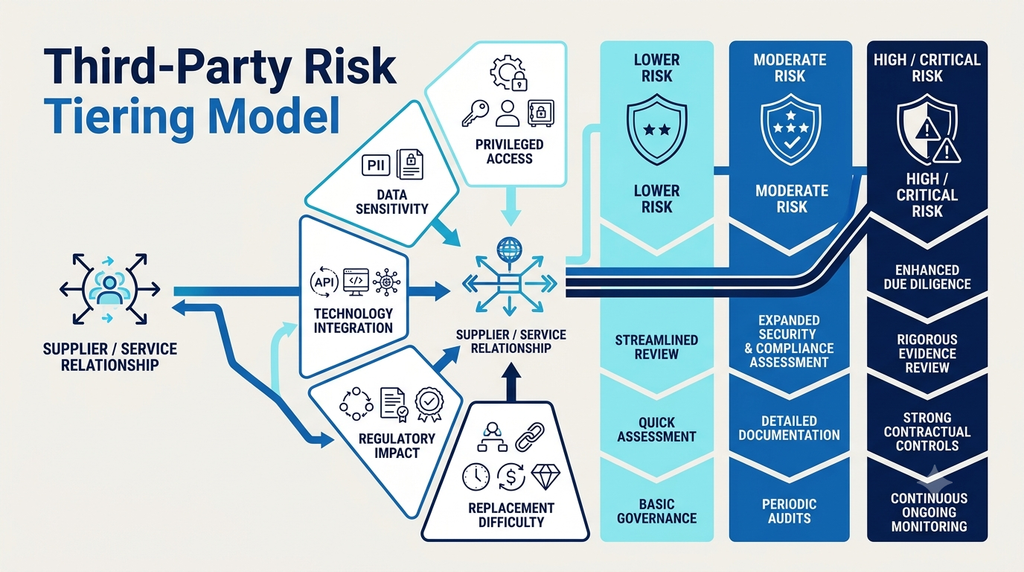
Not every supplier creates the same level of risk. A risk-based program should determine the inherent risk of the relationship before deciding how much due diligence is required.
Classification factors may include:
- Sensitivity of information involved
- Volume of information processed
- Privileged or administrative access
- Network or system connectivity
- Criticality of the supported business service
- Ability to interrupt operations
- Use of subcontractors
- Regulatory relevance
- Customer impact
- Difficulty of replacement
- Geographic concentration
Lower-Risk Suppliers
Suppliers with limited access, no sensitive data, low operational dependency, and minimal technology integration may require streamlined due diligence.
Moderate-Risk Suppliers
Suppliers that process internal information, integrate with enterprise systems, or support meaningful business processes may require broader assessment and periodic review.
High-Risk or Critical Suppliers
Suppliers with sensitive data, privileged access, critical-service dependencies, significant regulatory impact, or the potential to materially disrupt operations should receive enhanced due diligence and ongoing monitoring.
3. Perform Due Diligence Before Commitment
Risk assessment is most effective before the organization becomes operationally dependent on the supplier. Once a service is implemented and business processes rely on it, negotiating additional controls or changing providers can become significantly more difficult.
Pre-contract due diligence should be proportionate to the supplier’s inherent risk and may evaluate:
- Security governance
- Identity and access controls
- Data protection
- Infrastructure and cloud security
- Vulnerability management
- Application security
- Security monitoring
- Incident response
- Business continuity and disaster recovery
- Privacy practices
- Subcontractor management
- Compliance and independent assurance
- Secure development practices
- Personnel security where relevant
4. Request Evidence Based on Risk
Questionnaires alone may provide limited assurance because answers are generally self-reported. Material suppliers should provide supporting evidence where appropriate.
Evidence may include:
- Independent audit or assurance reports
- Relevant certifications
- Security policies and standards
- Architecture information
- Penetration-test summaries
- Vulnerability-management information
- Business continuity and recovery information
- Incident-response documentation
- Data-processing documentation
- Subprocessor information
- Security testing or assessment results
The goal is not to collect the largest possible evidence package. Evidence should help validate the controls most relevant to the risk created by the relationship.
5. Evaluate the Supplier’s Security Control Environment
Assessment should determine whether the supplier’s controls are appropriate for the service and risk rather than simply whether a security program exists.
Governance
Review security ownership, policy governance, risk management, security responsibilities, and oversight of important services.
Identity & Access
Assess authentication, privileged access, access reviews, service identities, administrative access, and account lifecycle management.
Data Protection
Understand data classification, encryption, access controls, storage, retention, deletion, transfer, backup, and key-management practices.
Infrastructure & Cloud Security
Evaluate hosting architecture, network security, secure configuration, vulnerability management, workload protection, and administrative controls.
Detection & Response
Review logging, monitoring, incident detection, response processes, escalation, investigation, and customer notification practices.
Resilience
Assess backup, recovery, redundancy, continuity planning, recovery objectives, testing, and dependence on critical infrastructure or subcontractors.
6. Understand Data and Privacy Exposure
Organizations should understand what information a supplier can access and how that information moves throughout the service.
Important questions include:
- What data will the supplier receive?
- Why is the data required?
- Where will it be stored and processed?
- Who can access it?
- Will subprocessors receive the data?
- How is the data protected?
- How long is it retained?
- How can it be deleted or returned?
- What happens when the contract ends?
- What regulatory or contractual restrictions apply?
Where practical, organizations should reduce unnecessary supplier access and avoid sharing information that is not required to deliver the service.
7. Assess Access and Integration Risk
A supplier that can access enterprise systems may create a substantially different risk profile from one operating an isolated external service.
Organizations should evaluate:
- User access
- Administrative or privileged access
- API integration
- Network connectivity
- Remote support mechanisms
- Service accounts
- Machine identities
- Credentials and secrets
- Data synchronization
- Inbound and outbound connectivity
Third-party access should follow least-privilege principles and be removed when no longer required.
8. Evaluate Fourth-Party and Concentration Risk
Organizations may contract directly with one supplier while the service depends on several additional providers. These subcontractors or fourth parties can create important operational and security dependencies.
Assessment should consider:
- Critical subprocessors
- Cloud hosting dependencies
- Identity providers
- Payment or communication platforms
- Software supply-chain dependencies
- Geographic concentration
- Shared infrastructure dependencies
- Alternative-provider availability
Concentration risk may become significant when multiple critical suppliers depend on the same underlying provider, region, platform, or technology.
9. Record Findings and Determine Residual Risk
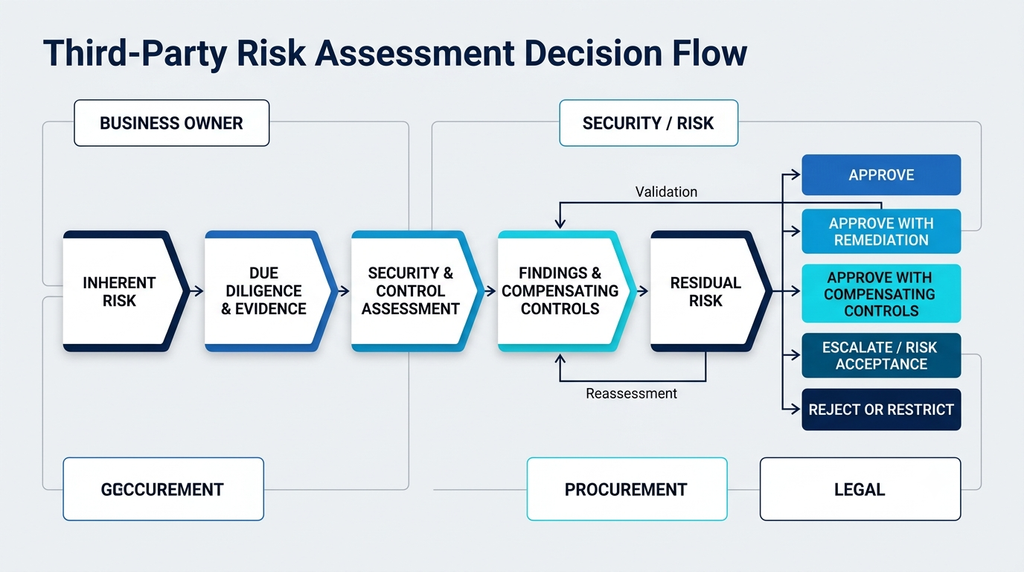
Assessment findings should distinguish between inherent risk, existing supplier controls, identified weaknesses, compensating controls, and the residual risk remaining after those factors are considered.
A finding should clearly document:
- The weakness or concern
- The associated risk
- Affected services or information
- Available supporting evidence
- Supplier response
- Compensating controls
- Recommended remediation
- Target date
- Risk owner
10. Make a Risk-Based Supplier Decision
A supplier assessment should support a decision rather than end with a questionnaire score.
Possible outcomes may include:
- Approve
- Approve with required remediation
- Approve with compensating controls
- Accept defined residual risk
- Restrict the proposed scope or access
- Escalate for additional review
- Reject the supplier or proposed service
Material residual risk should be accepted by an appropriate business or risk owner rather than implicitly transferred to the security team.
11. Integrate Security Requirements Into Contracts
Risk assessment findings should influence contractual requirements before the relationship is finalized where possible.
Depending on the service and risk, contracts may need to address:
- Information-security obligations
- Data protection and privacy requirements
- Security incident notification
- Subprocessor requirements
- Access-control expectations
- Vulnerability management
- Business continuity and recovery
- Audit or assurance rights
- Security evidence
- Data return and deletion
- Termination obligations
- Material security changes
The specific contract language should be appropriate to the business relationship, applicable law, and organizational requirements.
12. Track Remediation to Closure
Supplier findings should not disappear after onboarding. Material weaknesses should be tracked through a defined remediation process.
Remediation tracking should capture:
- Finding
- Risk rating
- Required corrective action
- Supplier owner
- Internal risk owner
- Target completion date
- Interim safeguards
- Status
- Evidence of completion
- Validation outcome
A supplier’s statement that remediation is complete should be validated where the issue is material to the relationship.
13. Monitor Risk Throughout the Relationship
Third-party risk can change after onboarding. Suppliers may change infrastructure, acquire other companies, introduce subprocessors, experience security incidents, modify services, change ownership, or expand the organization’s use of the platform.
Ongoing monitoring may consider:
- Security incidents
- Material service changes
- Changes in subprocessors
- Independent assurance updates
- Certificate expiration
- New vulnerabilities affecting the service
- Changes in regulatory exposure
- Service availability
- Open remediation items
- Changes in business criticality
Monitoring intensity should be proportionate to supplier risk and criticality.
14. Reassess Suppliers Based on Risk
Periodic reassessment provides an opportunity to confirm whether the supplier’s risk profile and controls remain appropriate.
Reassessment frequency can be based on factors such as:
- Supplier risk tier
- Business criticality
- Data sensitivity
- Previous findings
- Material service changes
- Security incidents
- Regulatory requirements
- Changes in access or integration
High-risk and critical suppliers generally require more frequent reassessment than low-risk relationships.
15. Manage Third-Party Incidents as Enterprise Incidents
A security event at a supplier can become an enterprise incident when the supplier holds organizational data, supports critical operations, provides trusted access, or hosts important technology.
Third-party incident procedures should define how the organization will:
- Receive and validate supplier notifications
- Determine affected systems and information
- Coordinate internal response teams
- Restrict supplier connectivity where necessary
- Revoke credentials or access
- Evaluate business-service impact
- Address regulatory and contractual obligations
- Communicate with relevant stakeholders
- Track remediation and recovery
- Reassess residual supplier risk
16. Offboard Suppliers Securely
Third-party risk management should continue through termination. Supplier access, credentials, integrations, data, and technical dependencies should be removed or transitioned when the relationship ends.
Offboarding should verify:
- User access has been revoked.
- Privileged access has been removed.
- Service accounts and credentials have been disabled or rotated.
- API integrations and network connectivity have been removed.
- Organizational data has been returned or deleted as required.
- Data-retention obligations are understood.
- Assets or equipment have been returned where applicable.
- Operational dependencies have been transitioned.
- Supplier records have been updated.
Third-Party Risk Assessment Checklist
Inventory & Classification
- The supplier and service are recorded in the enterprise inventory.
- A business owner is identified.
- Data, access, integrations, and operational dependencies are understood.
- The supplier has an appropriate inherent-risk classification.
Due Diligence
- Assessment depth reflects supplier risk.
- Relevant supporting evidence has been reviewed.
- Security, privacy, resilience, and compliance requirements are assessed.
- Subprocessors and significant dependencies are understood.
Risk Decision
- Material findings are documented clearly.
- Residual risk is understood.
- Required remediation has owners and target dates.
- Material risk acceptance has an accountable owner.
Contract & Onboarding
- Relevant security obligations are reflected in the contract.
- Supplier access follows least privilege.
- Required monitoring and incident-notification processes are established.
- Outstanding remediation is tracked after onboarding.
Lifecycle Management
- Risk is monitored according to supplier tier.
- Material changes trigger additional review.
- Reassessment occurs according to risk.
- Offboarding removes access, data, credentials, and dependencies appropriately.
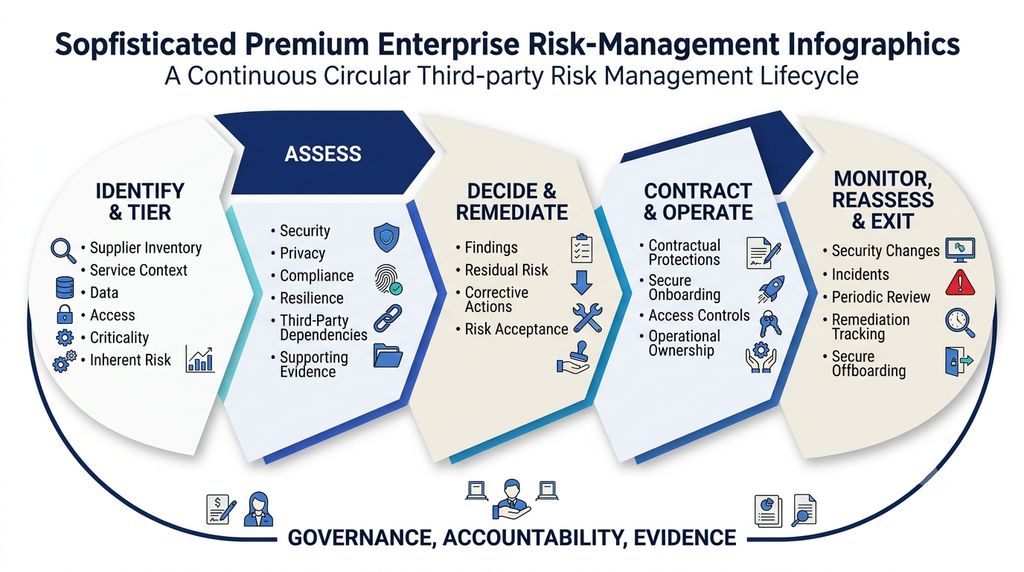
17. Manage Third-Party Risk Through the Full Lifecycle
Phase 1 — Identify & Tier
Understand the proposed service, business owner, information involved, access, integrations, criticality, and inherent risk.
Phase 2 — Assess
Perform proportionate security, privacy, compliance, resilience, and technology due diligence supported by relevant evidence.
Phase 3 — Decide & Remediate
Evaluate findings and residual risk, establish corrective actions, apply compensating controls where appropriate, and determine whether the supplier can be approved.
Phase 4 — Contract & Operate
Establish contractual requirements, onboard securely, restrict access appropriately, monitor material risks, and track outstanding remediation.
Phase 5 — Monitor, Reassess & Exit
Monitor supplier changes and incidents, reassess according to risk, and perform secure offboarding when the relationship ends.
18. Measure Third-Party Risk Management
Third-party risk metrics should help leadership understand exposure, control performance, and remediation rather than simply count completed questionnaires.
| Area | Example Indicator |
|---|---|
| Inventory | Active suppliers with identified owners and risk classification |
| Assessment | Required supplier assessments completed before onboarding |
| Critical Suppliers | High-risk suppliers assessed and monitored according to defined requirements |
| Findings | Material supplier findings within agreed remediation timelines |
| Access | Third-party privileged access reviewed and appropriately controlled |
| Contracts | Material supplier relationships containing defined security requirements |
| Monitoring | Critical suppliers covered by ongoing risk monitoring |
| Offboarding | Terminated suppliers with confirmed access and data disposition |
Common Third-Party Risk Management Mistakes
- Applying the same questionnaire and assessment depth to every supplier.
- Performing security review only after the contract has already been signed.
- Relying exclusively on supplier self-attestation.
- Treating certifications as proof that every relevant control is adequate.
- Assessing the supplier but overlooking the specific service being purchased.
- Failing to understand privileged access, integrations, or machine identities.
- Ignoring fourth-party and concentration dependencies.
- Documenting findings without assigning remediation ownership.
- Completing onboarding but failing to monitor changes throughout the relationship.
- Leaving supplier credentials and integrations active after termination.
CIAETO Perspective
CIAETO views third-party risk management as a lifecycle discipline rather than a questionnaire exercise. The objective is to understand how an external relationship can affect enterprise data, technology, security, compliance, resilience, and business services, and then apply oversight proportional to that exposure.
A sustainable program combines reliable supplier inventory, risk-based tiering, evidence-driven assessment, clear risk ownership, practical contractual safeguards, remediation tracking, continuous monitoring, reassessment, and secure offboarding. This helps organizations focus their strongest controls on the external relationships capable of creating the greatest enterprise impact.
Key Takeaways
- Third-party risk should be managed throughout the complete supplier lifecycle.
- Supplier assessment depth should be based on inherent risk rather than applied uniformly.
- Due diligence is most valuable before contractual and operational dependency is established.
- Material assessments should use supporting evidence rather than questionnaires alone.
- Supplier risk includes data, access, technology, resilience, subcontractor, and concentration dependencies.
- Assessment findings should lead to a clear risk decision and accountable remediation.
- Security requirements should be integrated into contracts where appropriate.
- Risk can change after onboarding, so critical suppliers require ongoing monitoring and reassessment.
- Secure supplier offboarding is an essential part of third-party risk management.
Related Services
- Third-Party Risk Management
- Governance, Risk & Compliance
- Security Architecture & Strategy
- Data Security & Governance
- Cloud & Infrastructure Security
Need Expert Guidance?
CIAETO helps organizations establish risk-based third-party assessment programs, evaluate supplier security and technology dependencies, identify material control gaps, strengthen governance and remediation processes, and build practical oversight across the full third-party lifecycle.