Modernizing the Workplace Means Modernizing How Work Happens
The digital workplace now extends far beyond corporate desktops and office networks. Employees may work across offices, homes, customer locations, mobile devices, cloud applications, collaboration platforms, virtual environments, and specialized business systems.
As these environments expand, organizations must balance employee productivity with security, reliability, supportability, governance, and cost. Fragmented identity systems, inconsistent device management, overlapping collaboration tools, legacy applications, manual provisioning, and complex support models can make the workplace difficult both for users and technology teams.
Digital workplace modernization should therefore be treated as an integrated transformation across identity, endpoints, applications, collaboration, security, employee experience, automation, and operating processes.
This guide provides a practical framework for assessing workplace maturity, defining the target experience, modernizing core technology foundations, improving security and support, and establishing a sustainable operating model for modern work.
1. Begin With the Employee Experience
Workplace modernization should start by understanding how employees actually interact with technology rather than by selecting individual products.
Organizations should understand:
- How employees access their applications
- How many authentication steps they experience
- How devices are requested and provisioned
- How quickly new employees become productive
- How collaboration works across locations and teams
- Where users experience performance or reliability problems
- How software is requested and delivered
- How incidents and service requests are resolved
- Which manual processes create unnecessary friction
User experience should be measured alongside security and technology efficiency. A highly controlled environment that creates excessive friction can encourage workarounds, while a highly convenient environment without appropriate controls can increase enterprise risk.
2. Assess the Current Workplace Environment
A modernization program needs a clear understanding of the existing technology estate, operating processes, dependencies, and pain points.
Identity
Assess directories, authentication, multi-factor authentication, single sign-on, conditional access, privileged access, identity lifecycle, and federation.
Endpoints
Review laptops, desktops, mobile devices, virtual desktops, operating systems, ownership models, device management, patching, encryption, and endpoint security.
Applications
Understand SaaS platforms, packaged applications, legacy applications, internally developed software, browser applications, and dependencies on local infrastructure.
Collaboration
Review messaging, meetings, document collaboration, knowledge management, file sharing, telephony, and overlapping collaboration platforms.
Security
Evaluate endpoint protection, device trust, identity controls, data protection, secure access, browser security, vulnerability management, and security monitoring.
Support & Operations
Assess service desk processes, device provisioning, software delivery, user support, monitoring, asset lifecycle, automation, and operational ownership.
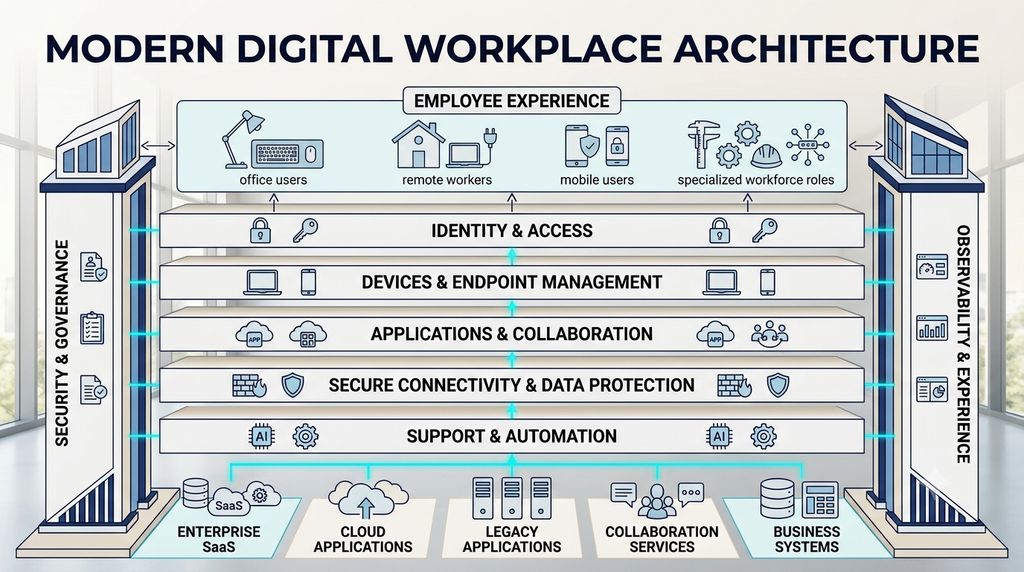
3. Define the Target Workplace Experience
A modernization program should define what the future employee technology experience should look like before individual technologies are selected or replaced.
A target experience may include:
- Consistent identity across enterprise services
- Secure access from approved locations and devices
- Streamlined authentication
- Rapid device provisioning
- Self-service application access where appropriate
- Reliable collaboration across locations
- Consistent endpoint security
- Automated lifecycle processes
- Fast support and recovery
- Accessible enterprise knowledge
The target state should be specific enough to guide architecture and investment decisions but flexible enough to accommodate different workforce roles and business requirements.
4. Make Identity the Workplace Control Plane
Modern work increasingly occurs outside a traditional network perimeter. Identity therefore becomes a primary mechanism for controlling access to applications, data, collaboration services, and administrative capabilities.
A modern identity foundation should consider:
- Single sign-on
- Multi-factor authentication
- Conditional access
- Device-aware access decisions
- Role-based access
- Privileged access management
- Automated joiner, mover, and leaver processes
- Federation with trusted services
- Identity risk monitoring
Identity modernization can simultaneously improve user experience and security by reducing password friction while strengthening authentication and access governance.
5. Modernize Endpoint Management
Traditional endpoint management models can become difficult to operate when users work from multiple locations and devices no longer connect regularly to corporate networks.
Modern endpoint management should support:
- Automated enrollment
- Standard configuration
- Security policy enforcement
- Operating-system updates
- Application deployment
- Encryption
- Compliance monitoring
- Remote support
- Remote wipe or retirement
- Device lifecycle management
Where practical, devices should be capable of being shipped directly to users and securely configured through automated enrollment rather than requiring extensive manual preparation.
6. Integrate Endpoint Security With Workplace Architecture
Endpoint security should be integrated with identity, device management, vulnerability management, secure access, and security operations.
Important capabilities may include:
- Endpoint detection and response
- Malware protection
- Disk encryption
- Host firewall controls
- Application control
- Device compliance
- Vulnerability visibility
- Browser protection
- Peripheral or device controls where needed
- Security telemetry integration
Security controls should be designed according to device risk, user role, information sensitivity, and business requirements rather than applied without context.
7. Simplify the Application Experience
Employees frequently interact with dozens of applications, each potentially using different authentication methods, access processes, interfaces, and support arrangements.
Application modernization should consider:
- Single sign-on integration
- Automated provisioning and deprovisioning
- Application rationalization
- Legacy application dependencies
- Browser-based delivery
- Virtual application or desktop requirements
- Role-based application catalogs
- Secure external access
- Application performance
Application rationalization can reduce both user complexity and operational cost by identifying redundant or overlapping tools.
8. Consolidate Collaboration Where Practical
Organizations often accumulate overlapping tools for messaging, meetings, file sharing, document collaboration, telephony, knowledge management, and project coordination.
Workplace modernization should determine which collaboration capabilities are strategic and where unnecessary duplication can be reduced.
Important considerations include:
- User adoption
- External collaboration
- Data governance
- Information retention
- Security controls
- Integration with business applications
- Meeting and telephony requirements
- Knowledge discovery
- Mobile experience
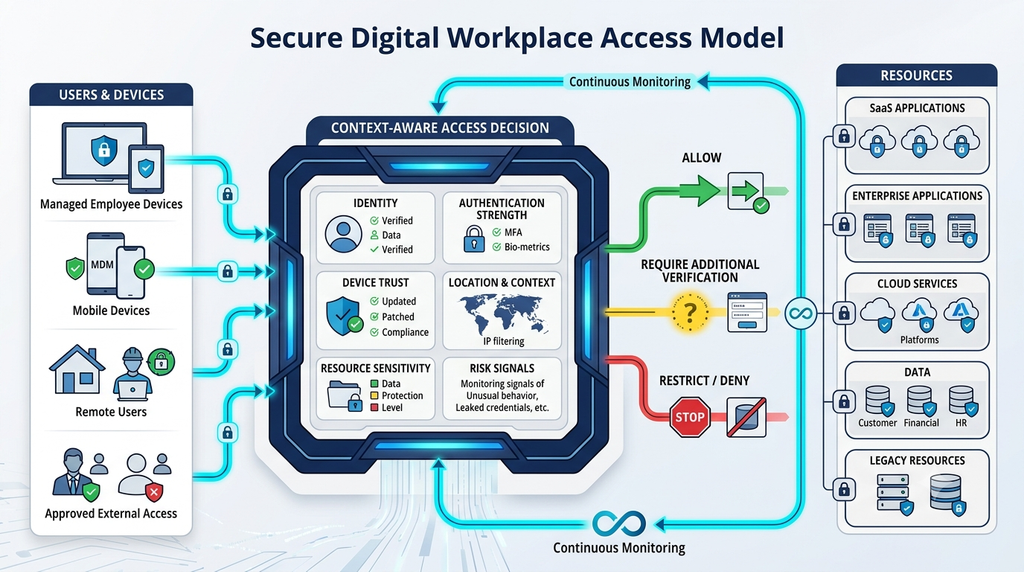
9. Design Secure Access for Hybrid Work
Hybrid work requires employees to securely access enterprise resources from different networks and locations. Traditional models that provide broad network access may create unnecessary exposure and operational complexity.
Secure-access architecture should consider:
- User identity
- Authentication strength
- Device trust and posture
- Application sensitivity
- User location and context
- Risk signals
- Least-privilege access
- Internet and SaaS security
- Legacy application access
The objective should be to provide access to the applications and resources a user needs rather than automatically extending broad network trust.
10. Protect Enterprise Data Across the Workplace
Modern workplace data may move between email, collaboration platforms, cloud storage, endpoints, SaaS applications, browsers, mobile devices, and external partners.
Data protection should consider:
- Information classification
- Access controls
- Encryption
- Data loss prevention
- External sharing
- Retention and deletion
- Device storage
- Cloud application usage
- Mobile access
- Insider-risk considerations
Controls should protect sensitive information without creating unnecessary barriers for normal collaboration.
11. Automate Joiner, Mover, and Leaver Processes
Employee lifecycle activities often require coordinated actions across identity, devices, applications, permissions, collaboration tools, and service-management systems.
Automation can improve both employee experience and control by supporting:
- Account creation
- Role-based access assignment
- Device provisioning
- Application licensing
- Group membership
- Access changes following role transitions
- Timely access revocation
- Device return and retirement
Authoritative HR or workforce information can help trigger lifecycle processes consistently when integrations are appropriately designed.
12. Improve Employee Self-Service
Not every request should require manual service-desk intervention. Well-designed self-service can improve response times while reducing operational workload.
Suitable capabilities may include:
- Password and authentication assistance
- Approved software requests
- Access requests
- Knowledge search
- Common troubleshooting
- Device status
- Service requests
- Automated request fulfillment
Self-service should be designed around common user needs and integrated with appropriate approval and security controls.
13. Modernize Workplace Support
Modern devices and cloud services provide greater telemetry and remote-management capabilities than traditional workplace environments. Support models should take advantage of this visibility.
Workplace operations can improve through:
- Endpoint health monitoring
- Remote diagnostics
- Automated remediation
- Application performance monitoring
- Experience analytics
- Improved knowledge management
- Integrated service-management workflows
- Proactive communication
The objective should gradually shift support from purely reactive incident handling toward proactive identification and resolution of recurring employee technology issues.
14. Measure Digital Employee Experience
Traditional workplace metrics such as ticket volume do not fully explain whether employees are able to work effectively.
Organizations can consider experience indicators such as:
- Device performance
- Application reliability
- Authentication success
- Time required to provision new employees
- Incident resolution time
- Recurring support issues
- Self-service completion
- Employee satisfaction
- Collaboration-service availability
Experience data should be combined with security, reliability, and cost measures to provide a balanced view of workplace performance.
15. Establish Workplace Governance
Digital workplace environments evolve continuously as applications, devices, collaboration tools, workforce patterns, and security requirements change.
Governance should establish clear ownership for:
- Identity architecture
- Endpoint standards
- Application portfolio
- Collaboration platforms
- Workplace security
- Employee experience
- Technology lifecycle
- Licensing and cost
- Support processes
Governance should also reduce uncontrolled technology proliferation while preserving enough flexibility for legitimate business needs.
Digital Workplace Modernization Checklist
Identity & Access
- Enterprise applications use consistent identity where practical.
- Strong authentication protects important access.
- User lifecycle processes are integrated with identity.
- Access decisions can consider user and device context.
Endpoints
- Devices can be enrolled and configured through standardized processes.
- Endpoint configuration and security posture are visible.
- Software and operating-system updates are managed consistently.
- Device retirement removes enterprise access and information appropriately.
Applications & Collaboration
- Application duplication is understood.
- Strategic collaboration platforms are defined.
- Application access is integrated with enterprise identity where practical.
- External collaboration has appropriate governance.
Security & Data
- Endpoint security is integrated with workplace operations.
- Remote access follows risk-based and least-privilege principles.
- Sensitive enterprise information has defined protection requirements.
- Workplace security telemetry is available to security operations.
Experience & Operations
- Employee technology experience is measured.
- Common requests can use self-service where appropriate.
- Support teams have useful device and application telemetry.
- Recurring user issues are analyzed and reduced.
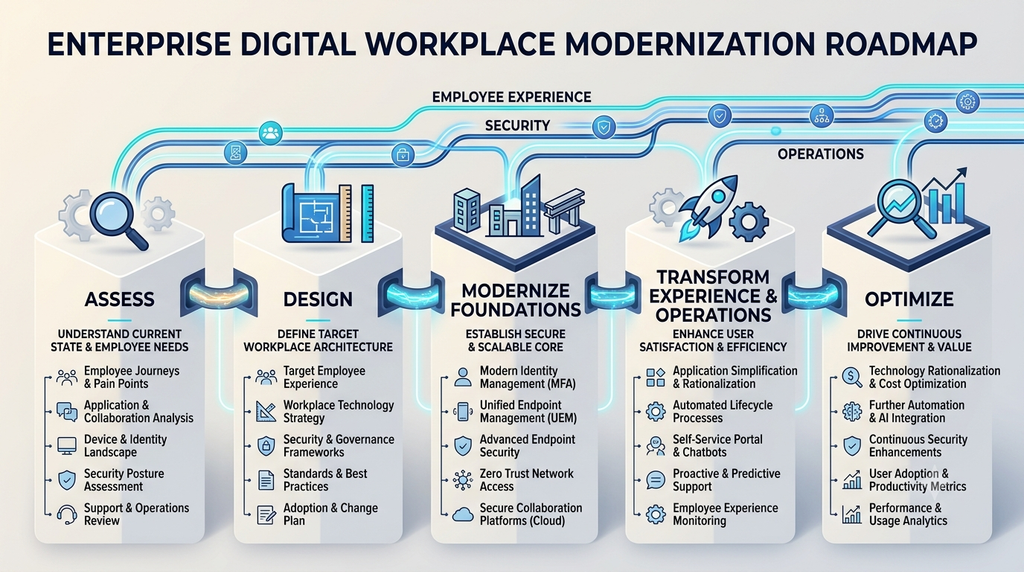
16. Modernize the Digital Workplace in Phases
Phase 1 — Assess
Understand employee journeys, identity, endpoints, applications, collaboration, security, support processes, technology dependencies, and major sources of friction.
Phase 2 — Design
Define the target employee experience, workplace architecture, identity model, device standards, application strategy, collaboration model, security controls, and operating responsibilities.
Phase 3 — Modernize Foundations
Strengthen identity, endpoint management, security, secure access, collaboration foundations, and automated lifecycle processes.
Phase 4 — Transform Experience & Operations
Simplify application access, improve self-service, modernize support, automate common workflows, and increase visibility into employee technology experience.
Phase 5 — Optimize
Measure experience, security, reliability, adoption, and cost; rationalize technology; improve automation; and continuously refine workplace services as employee needs evolve.
17. Measure Workplace Modernization Outcomes
Modernization should be measured through employee experience, security, operational efficiency, reliability, and technology simplification rather than only through project completion.
| Area | Example Indicator |
|---|---|
| Employee Experience | Reduction in recurring technology friction affecting employees |
| Provisioning | Time required to provide new employees with usable devices and required access |
| Identity | Strategic workplace applications using standardized authentication and access controls |
| Endpoints | Managed devices meeting defined configuration and security requirements |
| Applications | Reduction in unnecessary or overlapping workplace applications |
| Support | Common issues resolved through automation, self-service, or proactive remediation |
| Security | Workplace access and devices covered by defined identity, endpoint, and monitoring controls |
| Reliability | Critical workplace services meeting defined operational expectations |
Common Digital Workplace Modernization Mistakes
- Treating workplace modernization primarily as a device-refresh project.
- Selecting new collaboration tools without addressing overlapping platforms and governance.
- Improving remote access without strengthening identity and device trust.
- Automating existing processes without first removing unnecessary steps.
- Applying workplace security independently from endpoint management and employee experience.
- Migrating applications without simplifying how users discover and access them.
- Measuring service-desk activity without measuring actual employee technology experience.
- Introducing new technology without defining lifecycle ownership and operating responsibilities.
- Assuming every workforce role requires an identical workplace architecture.
CIAETO Perspective
CIAETO views the digital workplace as an integrated enterprise technology environment rather than a collection of employee devices and collaboration tools. Identity, endpoints, applications, secure access, information protection, automation, support, and employee experience should operate as connected capabilities.
A practical modernization program should simplify how employees access technology while strengthening enterprise control and improving operational efficiency. By standardizing core foundations and automating repeatable lifecycle processes, organizations can create workplace services that are easier for employees to use and easier for technology teams to operate securely at scale.
Key Takeaways
- Digital workplace modernization should begin with employee journeys and business requirements.
- Identity is a foundational control for modern hybrid work.
- Endpoint management and endpoint security should operate as integrated capabilities.
- Application and collaboration rationalization can reduce both user complexity and operational cost.
- Hybrid access should provide users with the resources they require rather than broad network trust.
- Automation can significantly improve employee onboarding, access management, and support.
- Employee technology experience should be measured alongside security and reliability.
- Successful modernization requires continuous governance rather than a one-time technology refresh.
Related Services
- Digital Workplace
- Identity & Privileged Access
- Network & Secure Access
- Managed IT Operations
- Cloud & Infrastructure Security
Need Expert Guidance?
CIAETO helps organizations assess digital workplace environments, modernize identity and endpoint foundations, strengthen secure access, simplify collaboration and application delivery, automate workplace processes, and improve employee technology experience across hybrid working environments.