Building Cyber Resilience Beyond Prevention
Cybersecurity programs have traditionally focused heavily on preventing attacks. Prevention remains essential, but modern enterprises must also prepare for the possibility that security controls may be bypassed, critical technology may become unavailable, or a cyber incident may disrupt normal business operations.
Cyber resilience extends cybersecurity beyond protection alone. It considers how an organization prepares for adverse events, identifies and contains threats, maintains critical operations, recovers affected services, and adapts following an incident.
A resilient enterprise therefore asks more than, “How do we prevent an attack?” It also asks, “How effectively can we operate, respond, recover, and improve when disruption occurs?”
This handbook provides a practical framework for examining those questions and identifying areas where cyber resilience can be strengthened.
1. Understand What Must Remain Resilient
Effective cyber resilience begins with understanding which business services, technology platforms, data, identities, applications, and third parties are essential to the organization.
Not every system has the same operational importance. Organizations should identify the services and technology dependencies whose disruption could create significant business impact.
- Critical business services and processes
- Applications supporting those services
- Infrastructure and cloud dependencies
- Critical data and information assets
- Privileged and operational identities
- Network and connectivity dependencies
- External providers and technology suppliers
- Recovery requirements and acceptable disruption thresholds
Key Questions
- Which services would create the greatest business impact if unavailable?
- Which systems and applications support those services?
- What dependencies could prevent successful recovery?
- Which identities have privileged access to critical environments?
- Which third parties could affect service availability?
- How long can each critical service reasonably remain disrupted?
2. Establish a Cyber Resilience Baseline
Before defining improvements, organizations need a realistic understanding of their current resilience capabilities. A readiness assessment should examine technical controls, organizational responsibilities, operational preparedness, and recovery capabilities together.
Governance
Determine whether cyber resilience responsibilities, decision authority, escalation paths, and accountability are clearly defined and understood.
Asset and Dependency Visibility
Assess whether the organization understands the applications, infrastructure, cloud services, identities, networks, data, and third-party dependencies supporting critical business services.
Preventive Security
Evaluate whether appropriate security controls reduce the likelihood of compromise and limit the potential impact of disruptive events.
Detection
Determine whether suspicious activity affecting important identities, systems, workloads, applications, and business services can be identified quickly enough to support effective response.
Incident Response
Review whether documented procedures, responsibilities, escalation mechanisms, communications arrangements, and scenario-specific response guidance are available and usable during an incident.
Recovery
Assess whether critical systems, applications, data, identity services, and business operations can be restored within acceptable timeframes.
Testing and Improvement
Determine whether response and recovery capabilities are exercised under realistic conditions and whether lessons from incidents and exercises result in tracked improvement actions.
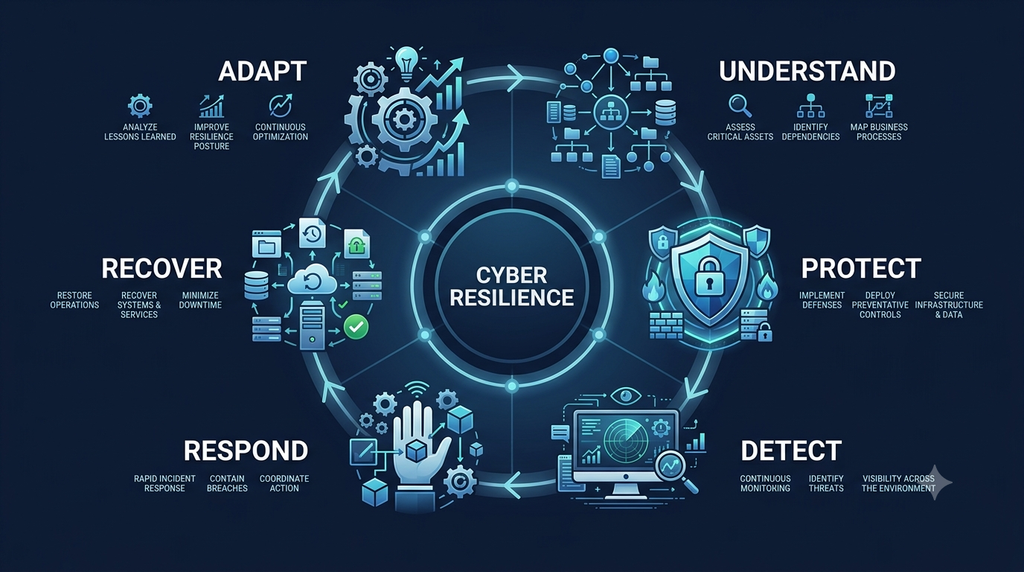
UNDERSTAND → PROTECT → DETECT → RESPOND → RECOVER → ADAPT → UNDERSTAND
- Understand: Business services, assets, dependencies, threats, and risks
- Protect: Preventive controls and risk reduction
- Detect: Visibility, monitoring, analytics, and identification
- Respond: Containment, coordination, investigation, and communication
- Recover: Restore critical services, systems, applications, and data
- Adapt: Lessons learned, remediation, testing, and continuous improvement
3. Strengthen Preventive Resilience
Cyber resilience does not replace preventive cybersecurity. Strong preventive controls reduce the likelihood that disruptive incidents will occur and can significantly limit their potential impact.
Identity Security
Protect privileged accounts, enforce strong authentication, apply least privilege, regularly review access, and reduce unnecessary standing privileges across critical environments.
Network Security
Segment critical environments, restrict unnecessary connectivity, secure remote access, and control communication between trust zones to limit lateral movement and operational impact.
Endpoint and Workload Protection
Protect endpoints, servers, cloud workloads, and other computing environments using appropriate hardening, vulnerability management, threat protection, monitoring, and response capabilities.
Application Security
Integrate security into application development, deployment, testing, and lifecycle management while prioritizing vulnerabilities according to exposure and business risk.
Data Protection
Classify sensitive information, control access, apply appropriate protection, and ensure critical data can be restored when disruption or destructive activity occurs.
Cloud Security
Establish secure configurations, identity controls, workload protection, visibility, logging, monitoring, and governance across cloud and hybrid environments.
4. Build Detection Around Business Impact
Detection capability should not be measured only by the quantity of alerts generated. A resilient security program requires sufficient visibility to identify activity that could threaten important business services and technology dependencies.
Relevant telemetry may include:
- Identity and authentication events
- Endpoint and server activity
- Network security events
- Cloud control-plane and workload activity
- Application and API events
- Privileged access activity
- Data security events
- Security platform alerts and relevant third-party signals
Readiness Question
Can the organization quickly identify which critical business services may be affected when a significant security event occurs?
If extensive manual investigation is required before dependencies and business impact can be understood, resilience maturity may need improvement.
5. Prepare for Coordinated Incident Response
Technology alone does not create cyber resilience. Significant incidents often require coordination across cybersecurity, IT operations, infrastructure, cloud teams, application owners, leadership, legal functions, communications teams, business stakeholders, and external service providers.
Incident response preparation should define:
- Roles and responsibilities
- Incident classification
- Escalation thresholds
- Decision authority
- Technical containment procedures
- Evidence preservation
- Internal and external communications
- Regulatory and contractual notification considerations
- Third-party coordination
- Transition from response into recovery
Response plans should be practical enough to use during stressful conditions rather than existing only as compliance documentation.
6. Prepare Scenario-Based Playbooks
A single generic incident-response plan is rarely sufficient for every disruptive scenario. Organizations should develop playbooks for events relevant to their technology environment, threat profile, and critical business services.
Ransomware
Contain affected environments, protect unaffected systems, assess identity compromise, preserve evidence, evaluate recovery options, and coordinate business continuity activities.
Privileged Account Compromise
Restrict compromised access, invalidate sessions and credentials where appropriate, identify privilege escalation, investigate affected resources, and restore trusted administrative access.
Cloud Account Compromise
Investigate identity and API activity, restrict malicious access, review configuration changes, identify affected workloads and data, and restore secure cloud operations.
Critical Application Disruption
Determine technical and business impact, activate continuity procedures where required, investigate the cause, coordinate application recovery, and validate restored functionality.
Third-Party Cyber Incident
Assess dependency exposure, determine whether connectivity or credentials require restriction, understand downstream impact, coordinate with the provider, and prepare alternative operating arrangements where necessary.
7. Design Recovery Before an Incident
Recovery should not begin when an incident occurs. Organizations should establish recovery requirements in advance and align technical recovery capabilities with business priorities.
- Recovery Time Objectives
- Recovery Point Objectives
- Backup architecture
- Backup isolation and protection
- Restoration procedures
- System and application dependencies
- Identity infrastructure recovery
- Network and cloud recovery dependencies
- Application recovery sequencing
- Alternative operating procedures
- Recovery validation
Backups alone do not demonstrate resilience. The organization must know whether critical services can actually be restored within acceptable business timeframes.
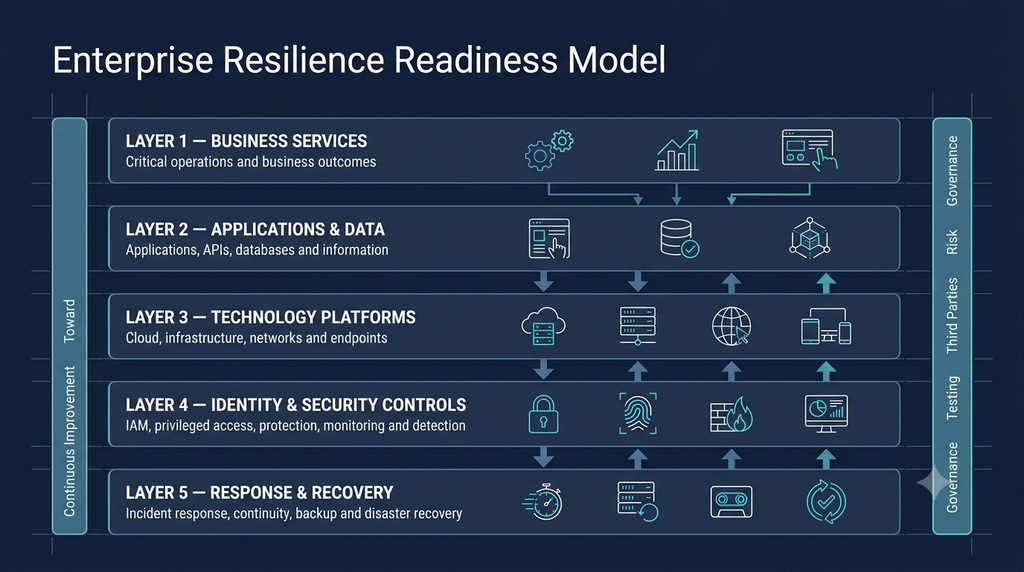
- Layer 1 — Business Services: Critical operations and business outcomes
- Layer 2 — Applications & Data: Applications, APIs, databases and information
- Layer 3 — Technology Platforms: Cloud, infrastructure, networks and endpoints
- Layer 4 — Identity & Security Controls: IAM, privileged access, monitoring, protection and detection
- Layer 5 — Response & Recovery: Incident response, continuity, backup and disaster recovery
Cross-cutting disciplines: Governance • Risk • Third Parties • Testing • Continuous Improvement
8. Test Resilience Under Realistic Conditions
A plan that has never been tested provides limited assurance. Testing should progressively validate people, processes, technology, communications, dependencies, recovery procedures, and decision-making.
Tabletop Exercises
Stakeholders work through realistic scenarios and discuss decisions, responsibilities, communications, escalation, containment, and recovery requirements.
Technical Response Exercises
Security and technology teams validate detection, investigation, containment, and technical response procedures under controlled conditions.
Recovery Testing
Critical systems, applications, and data are restored to verify that documented recovery procedures and dependencies actually work.
Cross-Functional Exercises
Cybersecurity, technology, business, legal, communications, operational, and leadership stakeholders respond together to validate coordination and decision-making.
Testing should identify weaknesses rather than simply demonstrate compliance. Every significant exercise should produce documented improvement actions with clear ownership.
9. Include Third Parties in Resilience Planning
Modern organizations depend extensively on external technology providers. Cloud platforms, SaaS applications, managed services, telecommunications providers, software vendors, and supply-chain partners can all affect operational resilience.
Organizations should understand:
- Which providers support critical services
- What systems and data those providers can access
- How provider outages could affect operations
- What security obligations exist contractually
- How significant incidents will be communicated
- Whether alternative providers or operating procedures exist
- How access can be restricted during a supplier incident
- How recovery responsibilities are divided
Third-party resilience should therefore be connected with broader third-party risk management rather than treated only as a procurement activity.
10. Measure Resilience With Meaningful Indicators
Resilience metrics should help decision-makers understand preparedness, identify weaknesses, and evaluate whether resilience capabilities are improving over time.
| Area | Example Indicator |
|---|---|
| Detection | Time required to identify significant security events |
| Response | Time required to contain high-impact incidents |
| Recovery | Ability to meet defined recovery objectives |
| Backups | Percentage of critical systems with successfully tested restoration |
| Exercises | Completion and outcomes of resilience exercises |
| Critical Services | Percentage with documented dependencies and recovery plans |
| Third Parties | Critical providers with assessed resilience dependencies |
| Improvement | Remediation actions completed following incidents and exercises |
Metrics should be interpreted in context. The objective is not simply to make every number smaller or larger, but to understand whether the organization’s ability to withstand disruption is improving.
11. Establish a Continuous Improvement Cycle
Cyber resilience is not a one-time project. Technology environments change, applications are introduced, cloud architectures evolve, suppliers change, new threats emerge, and business priorities shift.
Organizations should periodically revisit:
- Critical service inventories
- Technology and third-party dependencies
- Risk assessments and threat scenarios
- Security controls and monitoring coverage
- Incident response plans and playbooks
- Recovery procedures and dependencies
- Exercise scenarios and outcomes
- Resilience metrics and improvement actions
Lessons from incidents, exercises, threat intelligence, architectural changes, and operational experience should feed directly into this improvement cycle.
Cyber Resilience Readiness Checklist
Governance & Business Context
- Critical business services have been identified.
- Resilience ownership and responsibilities are documented.
- Business impact and disruption tolerance are understood.
- Cyber resilience is connected with enterprise risk management.
Technology & Dependencies
- Critical applications and infrastructure are mapped.
- Cloud and network dependencies are understood.
- Critical data is identified.
- Privileged identities supporting critical systems are known.
- Important third-party dependencies are documented.
Protection & Detection
- Critical systems have appropriate preventive controls.
- Privileged access is appropriately protected.
- Relevant security telemetry is collected.
- Detection covers critical environments.
- High-impact events have defined escalation paths.
Incident Response
- Incident response responsibilities are documented.
- Scenario-specific playbooks exist.
- Communication procedures are defined.
- Third-party coordination procedures exist.
- Decision authority is understood.
Recovery
- Recovery objectives are defined.
- Critical systems have protected backups where appropriate.
- Restoration procedures are documented.
- Recovery dependencies are understood.
- Recovery procedures have been tested.
Testing & Improvement
- Tabletop exercises are conducted.
- Technical response capabilities are tested.
- Recovery exercises are performed.
- Findings are assigned clear owners.
- Improvement actions are tracked to completion.
12. A Practical Cyber Resilience Roadmap
Organizations do not need to transform every resilience capability simultaneously. A structured improvement program can prioritize the areas that create the greatest reduction in business risk.
Phase 1 — Assess
Identify critical services, technology dependencies, relevant threats, existing capabilities, weaknesses, and resilience gaps.
Phase 2 — Prioritize
Prioritize improvements according to business impact, cyber risk, critical dependencies, operational requirements, and realistic implementation constraints.
Phase 3 — Strengthen
Improve preventive security, visibility, detection, incident response, recovery capabilities, third-party resilience, and governance.
Phase 4 — Validate
Exercise response and recovery capabilities under realistic scenarios and validate whether critical business objectives can be maintained or restored.
Phase 5 — Improve
Use lessons, metrics, incidents, exercises, threat changes, and technology evolution to continuously strengthen resilience.
[OPTIONAL DIAGRAM 3 — INSERT HERE: Assess → Prioritize → Strengthen → Validate → Improve]
CIAETO Perspective
CIAETO views cyber resilience as an enterprise capability rather than a collection of isolated cybersecurity controls. Organizations should connect security architecture, identity protection, monitoring, incident response, recovery, business continuity, third-party dependencies, and governance around the services that matter most to the business.
A practical resilience program does not require every capability to reach maximum maturity at the same time. The priority is to understand critical dependencies, identify meaningful gaps, strengthen the controls and processes that reduce business impact, validate those capabilities through testing, and continuously improve as the environment changes.
Key Takeaways
- Cyber resilience extends cybersecurity beyond prevention into response, recovery, continuity, and improvement.
- Resilience planning should begin with critical business services and their technology dependencies.
- Identity, network, endpoint, application, data, and cloud controls should work together to reduce disruption risk.
- Detection should incorporate business context rather than focusing only on alert volume.
- Incident response and recovery capabilities should be tested under realistic scenarios.
- Third-party dependencies must be incorporated into resilience planning.
- Cyber resilience requires continuous reassessment as technology, threats, suppliers, and business priorities evolve.
Related Services
- Cybersecurity Consulting
- Security Architecture & Strategy
- Managed Detection & Response
- Identity & Privileged Access
- Governance, Risk & Compliance
Need Expert Guidance?
CIAETO helps organizations assess cyber resilience, identify critical dependencies and readiness gaps, strengthen security and response capabilities, and develop practical approaches for maintaining and recovering critical technology services through disruptive cyber events.