Responsible AI Begins With Business Purpose
Artificial intelligence is becoming part of enterprise decision-making, customer experiences, software development, security operations, analytics, automation, and knowledge work. Generative AI has accelerated this adoption by making sophisticated AI capabilities accessible to a much broader range of employees and business functions.
However, rapid adoption also introduces new forms of risk. Organizations must consider data exposure, inaccurate outputs, inappropriate automation, security vulnerabilities, regulatory obligations, intellectual property, privacy, model behavior, third-party dependencies, and the consequences of relying on AI for important decisions.
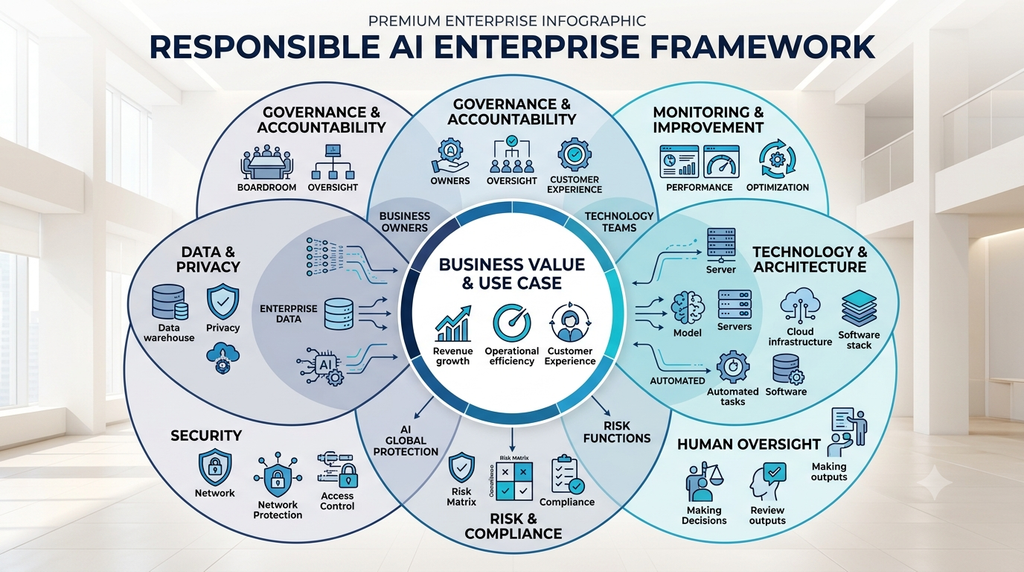
Responsible AI does not mean preventing innovation. It means establishing the governance, technology, security, and operating practices required to use AI with appropriate control and accountability.
This framework provides a practical approach for identifying AI opportunities, assessing risk, establishing governance, protecting data and systems, maintaining human oversight, deploying AI responsibly, and continuously monitoring outcomes.
1. Define the Business Purpose Before Selecting AI
AI initiatives should begin with a clearly defined business problem or opportunity rather than with a technology looking for a use case.
Potential objectives may include:
- Improving employee productivity
- Automating repetitive processes
- Improving customer experiences
- Accelerating analysis and decision support
- Improving software engineering workflows
- Enhancing security and operational analysis
- Extracting value from enterprise knowledge
- Creating new digital products and services
For each use case, organizations should identify the expected outcome, affected users, required data, decision impact, acceptable level of automation, and how success will be measured.
2. Establish AI Governance and Accountability
AI governance should define how decisions about AI are made, who is accountable for them, and which requirements apply throughout the lifecycle.
Governance responsibilities may span:
- Business leadership
- Technology and architecture
- Data and analytics
- Cybersecurity
- Privacy
- Legal and compliance
- Risk management
- Procurement and third-party management
- Application and product owners
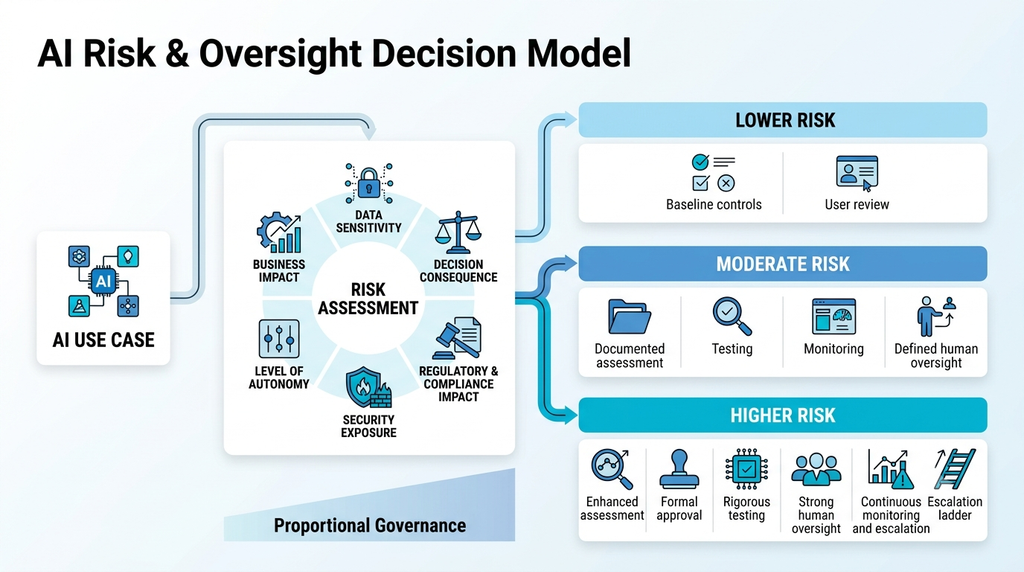
The governance model should be proportional to risk. A low-impact productivity assistant should not necessarily require the same oversight as an AI system influencing financial, employment, security, healthcare, or other consequential decisions.
3. Create an Enterprise AI Use-Case Inventory
Organizations cannot govern AI effectively if they do not know where it is being used. An AI inventory should provide visibility into approved AI systems, embedded AI capabilities, third-party AI services, internally developed models, and important business use cases.
Useful inventory information includes:
- Business owner
- Technology owner
- Business purpose
- AI capability or model
- Data used
- External providers
- Users and affected stakeholders
- Decision or automation impact
- Risk classification
- Approval and review status
4. Classify AI Use Cases by Risk
Not every AI use case creates the same level of risk. Organizations should apply a consistent classification process so governance requirements can increase with potential impact.
Lower-Risk Use Cases
Examples may include internal brainstorming, summarization of non-sensitive information, productivity assistance, or low-impact content support where outputs are reviewed before use.
Moderate-Risk Use Cases
These may influence business processes, interact with enterprise data, generate customer-facing material, automate operational activities, or support decisions where errors could create meaningful consequences.
Higher-Risk Use Cases
These may involve sensitive information, significant automated decisions, regulated activities, security-critical operations, material financial impact, safety implications, or decisions affecting individuals.
Risk classification should determine the required level of assessment, testing, approval, monitoring, documentation, and human oversight.
5. Establish Data Governance for AI
AI systems depend heavily on data. Poor data governance can create privacy, confidentiality, quality, intellectual-property, security, and reliability risks.
Organizations should understand:
- What data an AI system receives
- Where that data originates
- Whether sensitive information is involved
- Whether data may be retained by third parties
- Whether data can be used for model training
- Where data is processed and stored
- Which users and systems can access it
- What retention and deletion requirements apply
Data minimization should be considered where AI can achieve the intended outcome without receiving unnecessary sensitive information.
6. Build Security Into AI Architecture
AI systems introduce security considerations across applications, models, APIs, data pipelines, integrations, identities, plugins, tools, and infrastructure.
Security architecture should consider:
- Authentication and authorization
- Privileged administrative access
- API security
- Secrets and credential management
- Prompt and input handling
- Output handling
- Data isolation
- Third-party integrations
- Model and application dependencies
- Logging and monitoring
AI functionality should be treated as part of the broader application and security architecture rather than as an isolated intelligence layer.
7. Evaluate AI-Specific Threats
AI-enabled applications can introduce attack paths that are less common in traditional software. The exact threats depend on the architecture, model, data, integrations, and level of autonomy.
Relevant scenarios may include:
- Prompt injection and manipulation
- Insecure output handling
- Sensitive information disclosure
- Excessive permissions granted to AI agents or tools
- Abuse of connected APIs and plugins
- Model or data supply-chain risk
- Unauthorized model access
- Manipulation of training or retrieval data
- Unexpected autonomous actions
Threat modeling should reflect what the AI system can actually access and do. An AI assistant that only generates text creates a different risk profile from an agent capable of changing systems or initiating transactions.
8. Preserve Appropriate Human Oversight
Organizations should determine when AI output can be used automatically and when human review is necessary. The appropriate level of oversight depends on the consequence of error and the reversibility of the resulting action.
Human oversight becomes increasingly important when AI:
- Influences consequential decisions
- Processes sensitive information
- Communicates externally on behalf of the organization
- Generates or modifies production code
- Changes infrastructure or security controls
- Initiates financial or operational transactions
- Performs actions that are difficult to reverse
Human review should be meaningful rather than ceremonial. Reviewers need sufficient information, authority, and time to challenge or reject AI recommendations.
9. Assess Third-Party AI Providers
Many enterprise AI capabilities depend on external models, SaaS services, APIs, data providers, or technology platforms. Organizations should understand the resulting dependencies before using them for important workloads.
Assessment areas may include:
- Security architecture and controls
- Data processing and retention
- Use of customer data for training
- Privacy commitments
- Subprocessors and dependencies
- Service availability
- Model and service change practices
- Audit and assurance information
- Contractual protections
- Exit and portability considerations
10. Test AI Before Production Deployment
AI testing should evaluate more than whether the system produces useful outputs. Testing should reflect the intended use case, foreseeable misuse, security risks, data sensitivity, and potential consequences of failure.
Testing may include:
- Functional performance
- Output quality and consistency
- Known failure scenarios
- Security testing
- Prompt and input manipulation
- Sensitive-data handling
- Authorization boundaries
- Integration behavior
- Human-review processes
- Recovery and rollback procedures
Higher-risk use cases should receive more rigorous validation before deployment.
11. Control AI Agents and Automated Actions
AI systems increasingly have the ability to interact with applications, APIs, data sources, development environments, and operational tools. As autonomy increases, access control becomes more important.
Organizations should consider:
- Which tools an AI agent can access
- Which actions it can perform
- Which data it can retrieve
- What credentials it uses
- Whether actions require approval
- How activity is logged
- How permissions are revoked
- How unexpected behavior is contained
AI agents should receive the minimum permissions required for their intended tasks. High-impact or irreversible actions should have additional safeguards and, where appropriate, explicit approval.
12. Monitor AI After Deployment
AI risk does not end when a system enters production. Models, underlying services, data, integrations, user behavior, and business requirements can change over time.
Post-deployment monitoring should consider:
- Output quality
- Security events
- Unexpected behavior
- Policy violations
- Data exposure
- User complaints and feedback
- Changes in model or provider behavior
- Changes in regulatory or contractual requirements
- Performance against intended business outcomes
13. Establish an AI Incident Response Process
Organizations should prepare for incidents involving AI systems rather than assuming traditional incident procedures will cover every scenario.
Potential AI incidents may involve sensitive-data disclosure, malicious manipulation, unauthorized actions, inappropriate automated decisions, compromised integrations, unexpected model behavior, or significant output failures.
Response procedures should define how teams can:
- Disable or restrict the AI capability
- Revoke credentials or integrations
- Preserve relevant logs and evidence
- Identify affected users, systems, and data
- Escalate to appropriate business and risk owners
- Restore safe operation
- Document lessons learned
Responsible AI Adoption Checklist
Strategy & Ownership
- Each important AI use case has a defined business purpose.
- Business and technology owners are identified.
- AI use cases are inventoried.
- Risk classification determines governance requirements.
Data & Privacy
- Data used by AI systems is understood.
- Sensitive information is appropriately controlled.
- Retention and third-party data usage are understood.
- Data minimization is considered where practical.
Security
- AI applications use appropriate authentication and authorization.
- AI-specific attack scenarios have been considered.
- Agents and integrations use least privilege.
- Important AI activity is logged and monitored.
Testing & Oversight
- AI systems are tested according to their risk and intended use.
- Human oversight is defined for consequential activities.
- High-impact actions include appropriate safeguards.
- Production behavior is monitored continuously.
Third Parties & Operations
- Important AI providers and dependencies are assessed.
- Provider data handling is understood.
- AI-specific incident procedures are documented.
- Use cases are periodically reassessed as technology and risk change.
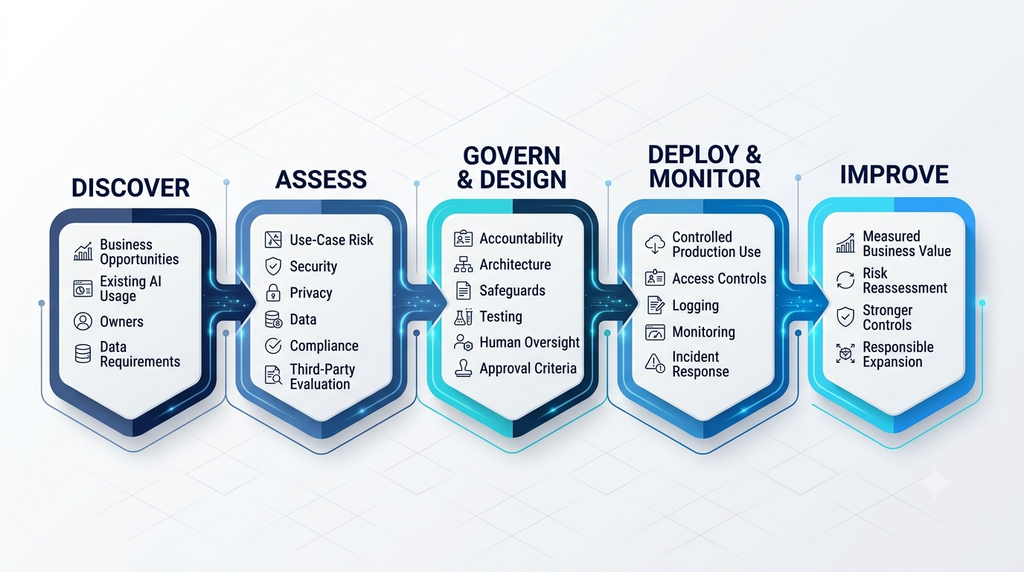
14. Adopt AI Through Controlled Phases
Phase 1 — Discover
Identify valuable AI opportunities, existing AI usage, business owners, data requirements, dependencies, and potential risks.
Phase 2 — Assess
Classify use cases according to impact and evaluate security, privacy, data, compliance, third-party, operational, and human-oversight requirements.
Phase 3 — Govern & Design
Define ownership, architecture, security controls, data protections, testing requirements, approval criteria, and operating processes.
Phase 4 — Deploy & Monitor
Introduce AI through controlled production deployment with appropriate monitoring, human oversight, logging, access controls, and response procedures.
Phase 5 — Improve
Measure business outcomes, reassess risk, respond to technology changes, strengthen controls, and expand successful use cases responsibly.
15. Measure Responsible AI Maturity
AI maturity should be measured by the organization’s ability to create value while maintaining appropriate governance, control, transparency, security, and accountability.
| Area | Example Indicator |
|---|---|
| Inventory | Material AI use cases recorded with accountable owners |
| Governance | AI use cases assessed according to defined risk criteria |
| Data | AI systems with documented data sources and handling requirements |
| Security | Important AI systems covered by defined security controls and monitoring |
| Testing | Higher-risk AI use cases validated before production deployment |
| Oversight | Consequential AI actions covered by defined human review or safeguards |
| Third Parties | Material AI providers assessed according to enterprise requirements |
| Operations | Production AI systems periodically reviewed for performance and risk |
Common Responsible AI Adoption Mistakes
- Adopting AI technology before defining a meaningful business problem.
- Applying identical governance requirements to every AI use case regardless of risk.
- Allowing sensitive enterprise data to enter AI systems without understanding how it is processed or retained.
- Focusing on model performance while overlooking application, identity, API, and integration security.
- Giving AI agents broader permissions than their tasks require.
- Using human review as a checkbox rather than a meaningful control.
- Completing an assessment before deployment but failing to monitor AI as models, providers, data, and use cases change.
CIAETO Perspective
CIAETO views responsible AI as an enterprise operating capability rather than a restriction on innovation. Organizations should be able to identify valuable AI opportunities, move promising use cases forward efficiently, and apply stronger controls when the potential impact requires them.
A sustainable approach connects business ownership, architecture, data governance, cybersecurity, risk, privacy, testing, human oversight, and operational monitoring throughout the AI lifecycle. This allows organizations to expand AI adoption while maintaining accountability and reducing avoidable exposure.
Key Takeaways
- Responsible AI should enable controlled innovation rather than prevent adoption.
- AI initiatives should begin with a defined business purpose and accountable owner.
- Governance requirements should increase with the risk and consequence of the use case.
- Data governance, security, privacy, and third-party risk must be considered throughout the AI lifecycle.
- AI agents and automated actions require particularly careful permission and oversight design.
- Human oversight should be meaningful for consequential decisions and actions.
- AI systems require continuous monitoring because models, providers, data, integrations, and business use can change.
Related Services
- AI & Intelligent Automation
- Data Security & Governance
- Application Security
- Governance, Risk & Compliance
- Digital & Technology Advisory
Need Expert Guidance?
CIAETO helps organizations identify practical AI opportunities, establish responsible AI governance, assess AI risk, strengthen security and data controls, and design enterprise AI adoption approaches that balance innovation with appropriate oversight and accountability.