Moving AI From Experimentation to Enterprise Value
Artificial intelligence and intelligent automation can improve how organizations analyze information, serve customers, develop software, operate technology, manage knowledge, and execute repetitive business processes. Yet moving from experimentation to sustainable enterprise value is significantly more difficult than demonstrating an isolated AI capability.
Successful implementation requires organizations to identify the right problems, understand existing processes, prepare data and integrations, design appropriate human oversight, establish security and governance, validate outcomes, and create an operating model capable of supporting AI after deployment.
The objective should not be to automate as much work as possible. It should be to apply AI and automation where they can improve business outcomes without creating unnecessary complexity, risk, or operational fragility.
This playbook provides a structured approach for moving enterprise AI and automation initiatives from opportunity identification through prioritization, design, pilot, production deployment, scaling, and continuous optimization.
1. Start With the Business Process, Not the AI Model
Organizations should begin by understanding the business process or decision that needs improvement. Starting with a particular AI technology can encourage teams to force AI into situations where simpler automation, process redesign, analytics, or conventional software would produce a better result.
Useful questions include:
- What problem is the organization trying to solve?
- Who performs the process today?
- Where are the major delays, errors, costs, or repetitive activities?
- Which decisions require human judgment?
- What information is required to complete the process?
- Which systems participate in the workflow?
- What would a successful improvement look like?
Understanding the current process also helps distinguish genuine automation opportunities from inefficiencies that should first be removed through process simplification.
2. Build an AI and Automation Opportunity Pipeline
AI opportunities can emerge across almost every business and technology function. A structured opportunity pipeline helps organizations compare them consistently rather than funding initiatives primarily because they are technically interesting.
Potential use cases may include:
- Enterprise knowledge assistance
- Document analysis and information extraction
- Customer-service assistance
- Software engineering support
- Security and operational analysis
- Workflow and approval automation
- Data analysis and reporting
- Content and communication assistance
- IT service operations
- AI-assisted decision support
Each opportunity should have a clear business owner and a preliminary description of the expected value, users, process, required data, integrations, and potential risk.
3. Prioritize Use Cases by Value, Feasibility, and Risk
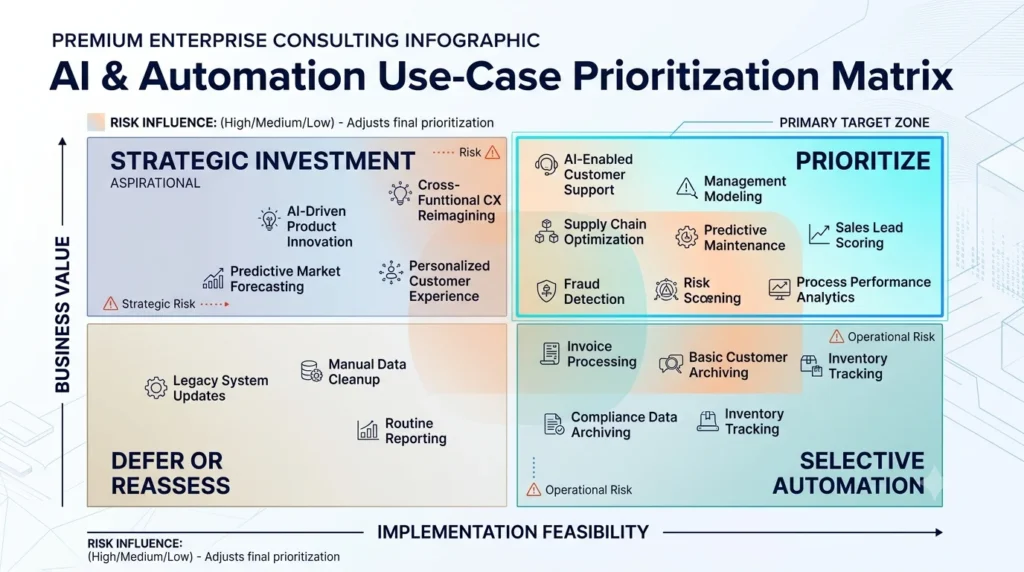
Organizations rarely have sufficient resources to pursue every AI idea simultaneously. Prioritization should balance potential business value against implementation feasibility and risk.
Business Value
Consider productivity improvement, customer impact, revenue opportunity, cost reduction, risk reduction, service quality, speed, scalability, and strategic importance.
Feasibility
Evaluate data availability, process maturity, integration complexity, technology capability, implementation effort, required skills, and operational readiness.
Risk
Consider data sensitivity, security exposure, regulatory requirements, decision consequence, reliability requirements, third-party dependency, and level of autonomous action.
High-value, achievable, manageable-risk opportunities are generally stronger candidates for early implementation than technically impressive initiatives with unclear business outcomes.
4. Decide What Should Actually Be Automated
Automation exists on a spectrum. Some activities require deterministic workflow automation, others benefit from AI assistance, and only selected scenarios justify higher levels of AI autonomy.
Traditional Automation
Best suited to predictable, rule-based processes where inputs, decisions, and expected outputs can be defined clearly.
AI-Assisted Work
AI produces analysis, recommendations, summaries, drafts, classifications, or other assistance while a person remains responsible for the final decision or action.
AI-Augmented Automation
AI performs selected interpretation or decision-support tasks inside a broader controlled workflow, while deterministic automation handles predictable actions.
Agentic or Autonomous Execution
AI can plan or perform multiple actions using connected systems and tools. This approach can create significant value but requires stronger permissions, safeguards, monitoring, testing, and human oversight because the potential impact of unexpected behavior is greater.
The goal is not maximum autonomy. Organizations should select the lowest level of autonomy capable of delivering the required business outcome effectively.
5. Simplify the Process Before Automating It
Automating an inefficient process can make inefficiency operate faster. Before implementing AI, organizations should determine whether unnecessary approvals, duplicated activities, manual handoffs, inconsistent inputs, or outdated process steps can be removed.
Process analysis should identify:
- Trigger and desired outcome
- Required inputs
- Decision points
- Manual activities
- System interactions
- Approvals
- Exceptions
- Failure paths
- Final outputs
A simplified process creates a stronger foundation for automation and makes outcomes easier to measure.
6. Prepare Data and Enterprise Knowledge
Many enterprise AI systems depend on organizational data, documents, knowledge bases, application records, or operational information. The usefulness of the AI system will therefore depend partly on the quality, accessibility, relevance, and governance of those information sources.
Teams should determine:
- Which information the use case requires
- Whether the source is authoritative
- Whether information is sufficiently current
- Whether sensitive data is involved
- How access permissions should be enforced
- How information will be updated
- Whether retrieval or integration quality can be measured
AI should not become an uncontrolled path around existing information-access requirements.
7. Design the Enterprise AI Architecture
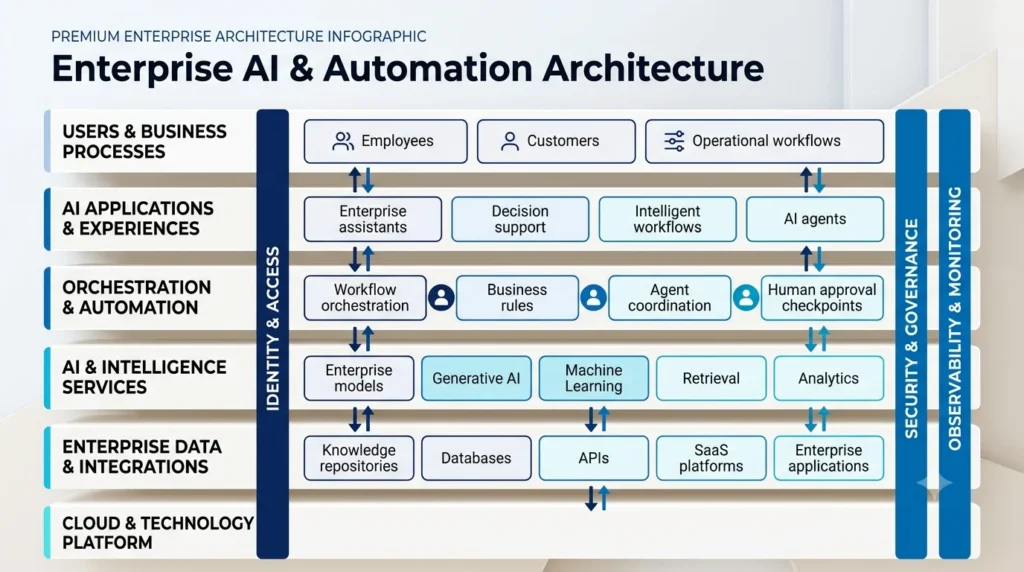
An enterprise AI solution frequently combines more components than the model itself. Architecture may include user interfaces, applications, APIs, orchestration, models, retrieval systems, enterprise data, identity, security controls, workflow engines, monitoring, and external services.
Architecture decisions should consider:
- User and system identity
- Model selection and abstraction
- Enterprise data integration
- Retrieval and knowledge architecture
- API and application integration
- Workflow orchestration
- Security boundaries
- Human approval points
- Logging and observability
- Failure and recovery paths
8. Design Human Oversight Into the Workflow
Human involvement should be intentionally designed rather than added after implementation. Different processes may require humans to review information, approve recommendations, resolve exceptions, authorize actions, or intervene when confidence is insufficient.
Higher levels of oversight are particularly appropriate when:
- The consequence of an incorrect action is significant.
- Sensitive or regulated information is involved.
- The AI system communicates externally.
- The process modifies important systems or data.
- The action is financially significant.
- The action is difficult to reverse.
Automation should remove unnecessary manual work without removing accountability where human judgment remains important.
9. Apply Least Privilege to AI Agents and Automation
Automation often requires access to enterprise applications, APIs, data, and infrastructure. AI agents may require similar access but can make dynamic decisions about how tools are used.
Permissions should therefore be designed carefully.
- Provide only the tools required for the defined task.
- Limit access to required data.
- Separate read and write permissions where practical.
- Protect credentials and secrets.
- Restrict high-impact actions.
- Require approval for selected operations.
- Record important agent actions.
- Provide a method to disable or revoke access quickly.
10. Build a Focused Pilot
A pilot should test the assumptions behind the use case without attempting to reproduce the full future enterprise platform immediately.
The pilot should define:
- Target users
- Business process
- Expected outcomes
- Data and integrations
- Security boundaries
- Human oversight
- Evaluation criteria
- Time period
- Exit criteria
A pilot is successful when it generates enough evidence to support a decision about whether to stop, redesign, extend, or productionize the initiative.
11. Evaluate Business and Technical Performance
AI evaluation should combine technical performance with business outcomes. A technically capable AI system may still be unsuccessful if it does not improve the underlying process or if users do not trust or adopt it.
Evaluation may include:
- Accuracy or output quality
- Task completion rate
- Processing time
- Manual effort reduced
- Exception rate
- User adoption
- User satisfaction
- Cost per transaction or task
- Security and policy violations
- Business outcome achieved
12. Productionize With Operational Controls
A successful prototype should not move directly into unrestricted enterprise use. Production deployment requires operational capabilities that experiments may not need.
Production readiness should consider:
- Service ownership
- Availability and capacity
- Authentication and authorization
- Security monitoring
- AI and application observability
- Cost monitoring
- Incident management
- Change management
- Fallback behavior
- Recovery procedures
- Support and escalation
13. Monitor AI and Automation in Production
AI systems and automated workflows should be monitored after deployment because performance can change as data, user behavior, models, prompts, integrations, dependencies, and business processes evolve.
Monitoring should cover both technology and outcomes.
- Availability and performance
- Output quality
- Automation success and failure rates
- Human intervention frequency
- Unexpected actions
- Security events
- Cost and consumption
- User feedback
- Business value realization
14. Scale Through Reusable Enterprise Capabilities
When multiple AI initiatives succeed, organizations should avoid creating separate technology stacks and governance models for every use case. Reusable capabilities can improve speed, consistency, security, and cost management.
Shared capabilities may include:
- Approved model access
- Identity and access integration
- Enterprise AI gateways or service layers
- Knowledge and retrieval services
- Workflow orchestration
- Security controls
- Logging and observability
- Evaluation frameworks
- Reusable integration patterns
- Governance and approval workflows
Reusable platform capabilities allow teams to focus more effort on business-specific problems while relying on common enterprise foundations.
Enterprise AI & Automation Implementation Checklist
Opportunity & Value
- The business problem is clearly defined.
- The existing process is understood.
- The use case has an accountable business owner.
- Expected outcomes and success measures are defined.
Architecture & Data
- Required data and knowledge sources are identified.
- Enterprise integrations and dependencies are understood.
- AI and automation architecture is documented.
- Failure and fallback behavior is defined.
Security & Control
- Identity and access requirements are defined.
- Agents and automation use least privilege.
- Sensitive information is appropriately protected.
- Important activities are logged and monitored.
Testing & Deployment
- The pilot has measurable evaluation criteria.
- Human oversight requirements are tested.
- Production ownership and support are established.
- Monitoring and recovery procedures are operational.
Scaling & Optimization
- Business outcomes are measured after deployment.
- Reusable capabilities are identified.
- Cost and consumption are monitored.
- Use cases are continuously reviewed and improved.
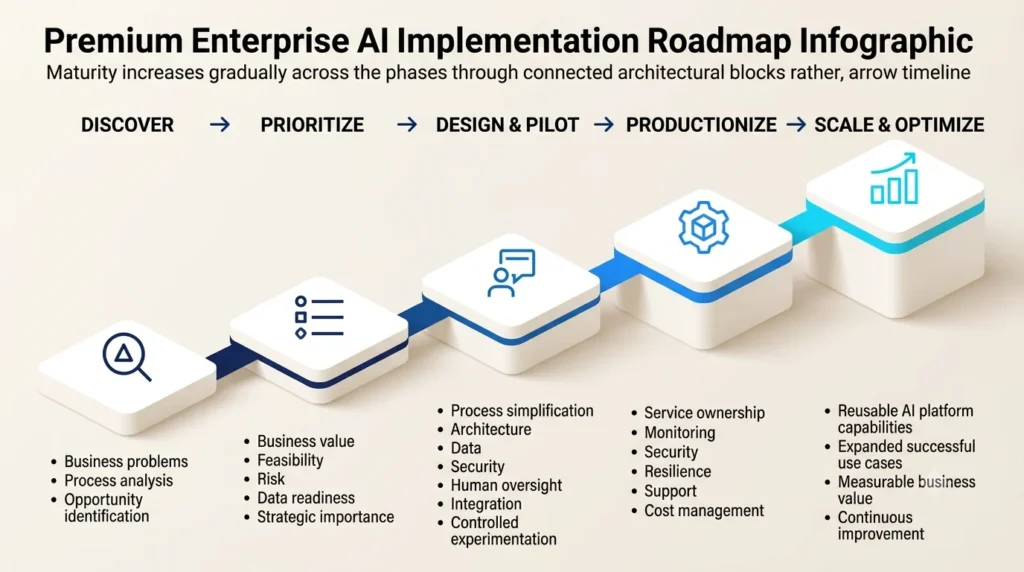
15. Implement Through Controlled Phases
Phase 1 — Discover
Identify business problems, process inefficiencies, automation opportunities, owners, expected outcomes, and potential constraints.
Phase 2 — Prioritize
Compare opportunities according to business value, feasibility, risk, implementation effort, data readiness, and strategic importance.
Phase 3 — Design & Pilot
Simplify the process, design the architecture, establish security and oversight, build a focused pilot, and validate business and technical assumptions.
Phase 4 — Productionize
Establish service ownership, operational monitoring, security controls, support, resilience, cost management, and production governance.
Phase 5 — Scale & Optimize
Expand successful use cases, introduce reusable platform capabilities, measure value, optimize cost and performance, and continuously improve controls and user experience.
16. Measure AI and Automation Outcomes
Enterprise AI programs should measure value rather than the number of pilots, models, or automation workflows created.
| Area | Example Indicator |
|---|---|
| Productivity | Reduction in manual effort or task completion time |
| Quality | Improvement in output quality or reduction in processing errors |
| Automation | Eligible workflow activities completed successfully without unnecessary intervention |
| Adoption | Target users consistently using the capability |
| Reliability | AI and automation services meeting defined operational objectives |
| Security | Important AI workflows operating within defined access and security controls |
| Economics | Cost of the capability compared with measurable business value |
| Scale | Successful use cases using approved reusable enterprise capabilities |
Common AI & Automation Implementation Mistakes
- Starting with an AI technology rather than a business problem.
- Automating inefficient processes without simplifying them first.
- Running many pilots without clear criteria for production adoption or termination.
- Measuring model performance without measuring business outcomes.
- Giving AI agents unnecessary access to enterprise systems and data.
- Moving prototypes into production without operational ownership, monitoring, or recovery procedures.
- Building isolated AI solutions when reusable enterprise capabilities could reduce duplication.
- Pursuing maximum automation instead of the appropriate balance between automation and human judgment.
CIAETO Perspective
CIAETO views enterprise AI and intelligent automation as tools for improving business and technology outcomes rather than objectives in themselves. Successful adoption begins with understanding the process, identifying where intelligence or automation genuinely adds value, and selecting an appropriate level of automation for the consequence and complexity involved.
A sustainable implementation model combines business ownership, process design, enterprise architecture, data, integration, security, human oversight, operational readiness, and measurable outcomes. Organizations can then move beyond isolated experimentation toward reusable AI capabilities that support controlled and scalable enterprise transformation.
Key Takeaways
- Start with the business process and desired outcome rather than the AI technology.
- Prioritize use cases according to value, feasibility, and risk.
- Use the lowest level of automation or autonomy that effectively achieves the required outcome.
- Simplify inefficient processes before automating them.
- Enterprise AI architecture extends beyond the model to data, identity, integrations, workflows, security, monitoring, and human oversight.
- Pilots should produce evidence that supports a clear decision to stop, redesign, extend, or productionize.
- Production AI requires ownership, monitoring, security, resilience, support, and cost management.
- Reusable enterprise capabilities are essential for scaling beyond isolated AI projects.
Related Services
- AI & Intelligent Automation
- Application Engineering
- Data Security & Governance
- Cloud & Infrastructure Security
- Digital & Technology Advisory
Need Expert Guidance?
CIAETO helps organizations identify practical AI and automation opportunities, prioritize high-value use cases, design secure enterprise architectures, develop controlled implementation approaches, and establish the operational foundations required to scale intelligent automation responsibly.