Compliance Readiness Is an Operational Capability
Enterprise compliance is often associated with audits, assessments, questionnaires, and regulatory deadlines. However, sustainable compliance depends on what happens throughout normal business and technology operations long before an assessment begins.
Organizations need to understand the obligations that apply to them, translate those requirements into practical controls, assign accountability, maintain evidence, identify weaknesses, and continuously verify that important controls continue to operate as intended.
A compliance program focused primarily on preparing evidence shortly before an audit can create unnecessary effort and provide limited visibility into whether controls are actually effective. A stronger approach integrates compliance requirements with governance, cybersecurity, technology operations, risk management, and business processes.
This guide provides a practical framework for assessing compliance readiness, organizing requirements, mapping controls, managing evidence, identifying gaps, preparing for assessments, and developing a sustainable compliance operating model.
1. Understand the Compliance Landscape
Compliance readiness begins by understanding which requirements apply to the organization and why. Requirements may originate from laws, regulations, industry standards, contractual commitments, customer expectations, internal policies, or corporate governance requirements.
The compliance landscape may include:
- Legal and regulatory obligations
- Industry-specific requirements
- Security and privacy standards
- Customer contractual requirements
- Third-party commitments
- Internal policies and standards
- Corporate governance requirements
- Assurance and certification objectives
Organizations should avoid treating every external framework as automatically applicable. Applicability should be established according to business activities, jurisdictions, customers, information processed, contractual commitments, and organizational objectives.
2. Define the Scope Clearly
Compliance programs become difficult to manage when scope is ambiguous. Organizations should define which business units, locations, systems, applications, infrastructure, processes, data, employees, and third parties fall within the relevant compliance boundary.
Scope decisions should consider:
- Business services
- Legal entities and operating locations
- Applications and technology platforms
- Cloud and infrastructure environments
- Networks and endpoints
- Data types and processing activities
- Users and privileged administrators
- Suppliers and service providers
- Shared enterprise services
Dependencies outside the immediate boundary should also be understood. A critical application may depend on identity, network, logging, backup, cloud, or third-party services that materially affect compliance even when those services are managed elsewhere.
3. Translate Requirements Into Practical Controls
Compliance requirements are not always written in the language used by engineering and operational teams. Organizations need to translate obligations into controls that can be implemented, owned, operated, tested, and evidenced.
A practical control definition should answer:
- What objective does the control achieve?
- Which requirement does it support?
- Who owns the control?
- How is the control implemented?
- Which systems or processes does it cover?
- How frequently does it operate?
- What evidence demonstrates operation?
- How will effectiveness be evaluated?
Controls should be written clearly enough that technology and business teams understand what is expected without needing to reinterpret the original compliance requirement repeatedly.
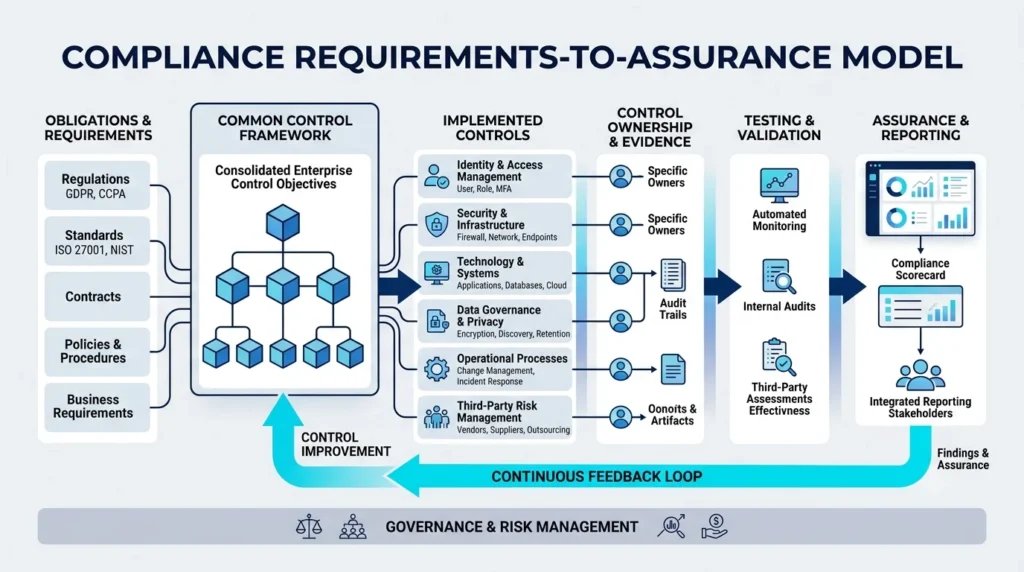
4. Build a Common Control Framework
Organizations operating against multiple frameworks can create unnecessary duplication if each requirement is managed independently. Many frameworks address similar underlying control objectives even when terminology differs.
A common control framework can map multiple obligations to shared enterprise controls across areas such as:
- Governance
- Asset management
- Identity and access
- Security architecture
- Network security
- Vulnerability management
- Data protection
- Logging and monitoring
- Incident response
- Business continuity and recovery
- Third-party risk
- Secure development
- Physical and personnel security
Instead of implementing separate controls for every framework, organizations can establish one well-designed control and map it to the relevant obligations where appropriate.
5. Assign Clear Control Ownership
A control without an accountable owner is difficult to maintain. Ownership should identify who is responsible for ensuring the control operates, who performs supporting activities, and who addresses failures.
Control ownership may span:
- Cybersecurity
- IT infrastructure
- Cloud engineering
- Network teams
- Application owners
- Identity teams
- Data owners
- Human resources
- Procurement
- Legal and privacy functions
- Business operations
The compliance or GRC function can coordinate the program, but it should not become the nominal owner of controls that are actually operated by technology or business teams.
6. Assess Control Design Before Testing Operation
Before determining whether a control operates consistently, organizations should first determine whether the control is designed appropriately to address its intended objective.
Design assessment should consider whether:
- The control addresses the relevant requirement.
- The scope is appropriate.
- The responsible owner is identified.
- The frequency is appropriate to the risk.
- The implementation method is sufficiently reliable.
- Exceptions can be identified and managed.
- Evidence can demonstrate that the control operates.
A consistently performed control can still be ineffective if its underlying design does not adequately address the intended risk or requirement.
7. Establish Evidence as Part of Normal Operations
Evidence should demonstrate that a control exists and operates. Collecting evidence only immediately before an audit often creates significant manual effort and increases the risk of incomplete or inconsistent records.
Evidence may include:
- Approved policies and standards
- System configurations
- Access-review records
- Security logs
- Vulnerability reports
- Change records
- Incident records
- Backup and recovery results
- Training records
- Risk assessments
- Supplier assessments
- Management approvals
Evidence should be attributable to the relevant system, control, period, and owner. Where practical, evidence collection should be automated or generated through established operational workflows.
8. Evaluate Operating Effectiveness
Once control design is understood, organizations should determine whether controls are operating consistently over the required period.
Testing may evaluate:
- Whether the control operated at the required frequency
- Whether the expected population was covered
- Whether exceptions were identified
- Whether exceptions were resolved appropriately
- Whether required approvals occurred
- Whether evidence is complete and reliable
- Whether the control achieved its intended objective
Testing approaches should be proportional to the importance, frequency, automation, and risk associated with the control.
9. Identify and Prioritize Compliance Gaps
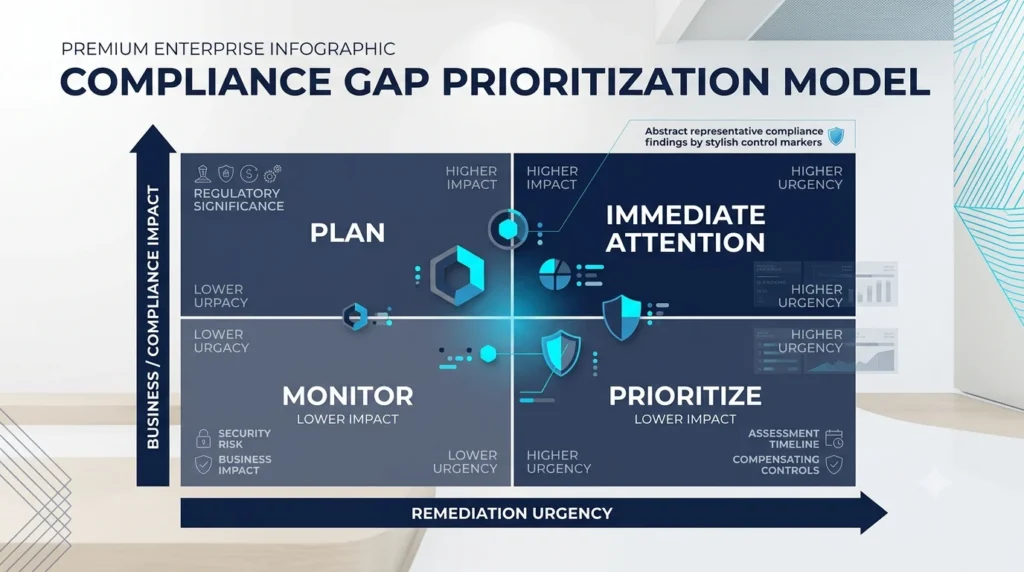
A readiness assessment should produce more than a list of failed requirements. Gaps should be evaluated according to the risk and effort associated with remediation.
Prioritization factors may include:
- Regulatory or contractual significance
- Security risk
- Business impact
- Control dependency
- Assessment timeline
- Remediation complexity
- Number of affected systems
- Availability of compensating controls
10. Build a Structured Remediation Plan
Each material gap should have a remediation plan that can be tracked to completion.
A useful remediation record should include:
- Gap description
- Affected requirement or control
- Risk or impact
- Remediation action
- Accountable owner
- Target completion date
- Dependencies
- Interim or compensating controls
- Current status
- Validation requirements
Closing a task should not automatically mean the gap is resolved. Remediation should be validated to confirm that the intended control has actually been established and is capable of operating effectively.
11. Manage Exceptions and Compensating Controls
Organizations may not always be able to implement a standard control immediately. Legacy technology, operational constraints, third-party dependencies, or business requirements can create exceptions.
Exceptions should be formally managed rather than becoming permanent undocumented deviations.
- Document the reason for the exception.
- Identify the affected requirement and risk.
- Assign an accountable owner.
- Evaluate compensating controls.
- Define an expiration or review date.
- Obtain appropriate approval.
- Track remediation where required.
Compensating controls should reduce the relevant risk meaningfully rather than simply provide documentation that an exception exists.
12. Integrate Third-Party Compliance Dependencies
Organizations increasingly depend on cloud providers, SaaS platforms, technology suppliers, managed services, and other external organizations. These dependencies can affect compliance even when the underlying service is operated outside the enterprise.
Organizations should understand:
- Which controls depend on third parties
- What responsibilities remain with the organization
- What assurance the supplier provides
- Whether contractual requirements support compliance obligations
- How supplier changes are monitored
- How deficiencies are escalated
- What evidence is available for assessments
Third-party assurance should complement rather than replace the organization’s understanding of its own responsibilities.
13. Prepare for Assessments Before the Audit Window
Assessment readiness should be validated before formal testing begins. This provides time to address missing evidence, unclear ownership, incomplete remediation, or inconsistent control operation.
Pre-assessment activities may include:
- Confirming scope
- Reviewing requirement and control mappings
- Validating control ownership
- Checking evidence availability
- Reviewing open exceptions
- Confirming remediation status
- Testing selected controls
- Reviewing documentation consistency
- Preparing responsible stakeholders
A readiness review should identify weaknesses while there is still sufficient time to address them rather than attempting to conceal them during an assessment.
14. Move From Periodic Compliance to Continuous Assurance
Technology environments change faster than traditional annual compliance cycles. Cloud resources, identities, applications, suppliers, vulnerabilities, and configurations can change continuously.
Organizations should therefore increase continuous visibility where practical through:
- Automated configuration monitoring
- Continuous security posture assessment
- Identity and access reviews
- Vulnerability monitoring
- Centralized evidence workflows
- Exception tracking
- Control-performance dashboards
- Automated notifications
- Periodic control-owner attestations
Automation does not remove the need for judgment, but it can reduce repetitive evidence gathering and help teams identify control failures earlier.
Enterprise Compliance Readiness Checklist
Scope & Requirements
- Applicable obligations and frameworks are identified.
- Compliance scope is clearly documented.
- Important technology and third-party dependencies are understood.
- Requirements are mapped to practical enterprise controls.
Controls & Ownership
- Controls have clearly defined objectives.
- Each material control has an accountable owner.
- Control design has been assessed.
- Control frequency and scope are documented.
Evidence & Testing
- Required evidence is defined for important controls.
- Evidence is retained through repeatable processes.
- Operating effectiveness is evaluated periodically.
- Evidence can be traced to the relevant control and assessment period.
Gaps & Exceptions
- Compliance gaps are risk-prioritized.
- Material remediation has accountable owners and target dates.
- Exceptions are formally documented and approved.
- Closed remediation is validated.
Assurance & Improvement
- Readiness is reviewed before formal assessments.
- Third-party dependencies are included in assurance activities.
- Control performance is monitored between audits.
- Lessons from assessments feed continuous improvement.
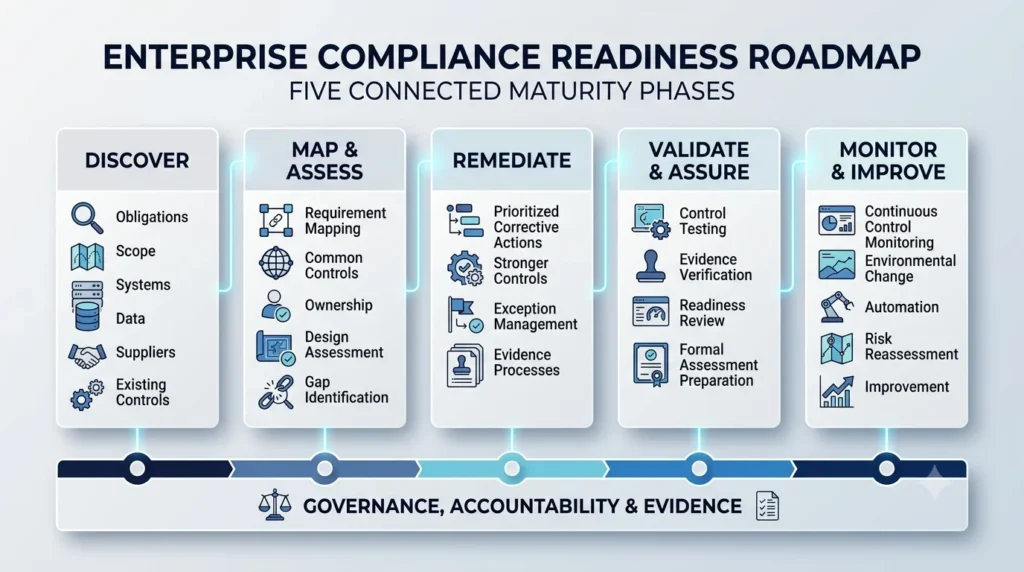
15. Build Compliance Readiness in Phases
Phase 1 — Discover
Identify applicable requirements, business context, technology scope, data, suppliers, existing policies, controls, and assessment objectives.
Phase 2 — Map & Assess
Translate requirements into controls, establish ownership, map existing capabilities, assess control design, and identify readiness gaps.
Phase 3 — Remediate
Prioritize weaknesses, implement or strengthen controls, manage exceptions, establish evidence processes, and validate remediation.
Phase 4 — Validate & Assure
Test operating effectiveness, verify evidence, review assessment readiness, resolve remaining issues, and prepare stakeholders for formal assurance activities.
Phase 5 — Monitor & Improve
Continuously monitor important controls, track environmental changes, reassess risk, automate evidence where practical, and improve the compliance operating model.
16. Measure Compliance Readiness
Compliance metrics should provide visibility into control health and readiness rather than simply report the number of requirements documented.
| Area | Example Indicator |
|---|---|
| Scope | Material systems and processes mapped to applicable requirements |
| Ownership | Important controls with accountable owners |
| Control Design | Controls assessed as appropriately designed |
| Evidence | Required control evidence available for the relevant period |
| Effectiveness | Controls operating according to defined requirements |
| Remediation | Material findings resolved within agreed timelines |
| Exceptions | Open exceptions within approved review periods |
| Assurance | Readiness issues identified and addressed before formal assessment |
Common Compliance Readiness Mistakes
- Treating compliance as an activity that begins shortly before an audit.
- Managing each framework independently when common enterprise controls could satisfy multiple requirements.
- Assigning controls to the compliance team even when operational responsibility belongs elsewhere.
- Collecting evidence manually without defining repeatable evidence requirements.
- Testing whether a control operates before determining whether it is designed appropriately.
- Closing remediation actions without validating that the control weakness has actually been resolved.
- Allowing exceptions to remain indefinitely without ownership or review.
- Assuming supplier certifications automatically satisfy the organization’s own compliance responsibilities.
- Measuring compliance primarily by completed documentation rather than control effectiveness.
CIAETO Perspective
CIAETO views compliance readiness as an outcome of effective governance and technology operations rather than a documentation exercise. Sustainable compliance requires organizations to understand their obligations, translate them into practical controls, assign ownership to the teams that operate those controls, and maintain evidence through normal business processes.
A stronger compliance model also reduces duplication by connecting multiple requirements to common enterprise controls and increasing continuous visibility into control health. This can improve assessment readiness while helping security, technology, risk, and business teams focus on the underlying risks that compliance requirements are intended to address.
Key Takeaways
- Compliance readiness should be built into normal technology and business operations.
- Applicability and scope should be established before controls are assessed.
- Requirements should be translated into clear, implementable, and testable controls.
- A common control framework can reduce duplication across multiple obligations.
- Control ownership should remain with the teams responsible for operating the control.
- Evidence should be generated and retained through repeatable processes rather than assembled immediately before an audit.
- Compliance gaps should be prioritized according to risk and validated after remediation.
- Continuous assurance can identify control deterioration earlier than periodic assessments alone.
Related Services
- Governance, Risk & Compliance
- Security Architecture & Strategy
- Third-Party Risk Management
- Cloud & Infrastructure Security
- Data Security & Governance
Need Expert Guidance?
CIAETO helps organizations assess compliance readiness, translate requirements into practical controls, identify security and governance gaps, strengthen evidence and ownership models, and build sustainable approaches to technology risk and compliance.